 Collate Ideas For Community Radio Policy

Introduction
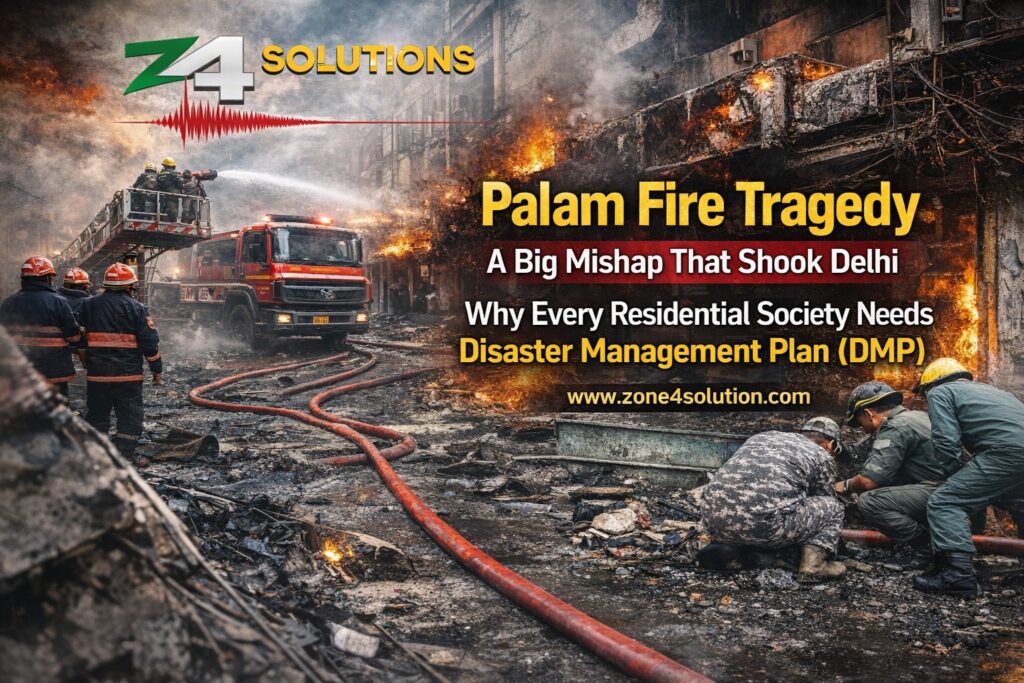
The recent fire incident in a multi-storied building in Palam, Delhi, which claimed the lives of seven people including three children, is yet another tragic reminder of the silent risks that exist within our residential spaces. This highlights the urgent need for a fire disaster management plan in Palam, especially in densely populated residential areas.
While such incidents often make headlines for a few days, the deeper systemic issues behind them rarely receive the sustained attention they deserve. This tragedy is not an isolated event. It reflects a broader and more concerning reality that a large number of residential societies in Delhi remain unprepared for disasters due to the absence of a proper fire disaster management plan in Palam and nearby areas.
The lack of structured planning, limited awareness, and weak enforcement of safety norms have created a situation where homes, which are expected to be safe havens, are increasingly becoming vulnerable spaces.
The Palam Incident: A Wake-Up Call
The Palam fire incident highlights the devastating consequences of unpreparedness. In high-density urban environments, where buildings are closely packed and populations are large, even a small fire can escalate rapidly into a major disaster.
Key concerns observed in such incidents include:
- Delayed evacuation due to lack of awareness
- Absence of clear escape routes
- Panic among residents
- Lack of coordination with emergency services
- Inadequate fire safety systems
The loss of children in such incidents is particularly heartbreaking, as it reflects the failure of systems meant to protect the most vulnerable, such as the recent fire. Much of the public debate has focused on the fire department’s response—questions about ladder height, hydraulic failure, and response time are being raised.
While these concerns are valid, they address only the response phase of a disaster. The more critical and often ignored question is:
Why did the disaster escalate to this level in the first place?
Disaster Response vs Disaster Management
Fire service is one of the emergency support functionaries; they act after an incident has occurred.
But disaster management is much broader. It includes:
- Preparedness
- Risk reduction
- Mitigation
- Planning
This responsibility lies with institutions such as the District Disaster Management Authority (DDMA).
The Missing Conversation: Role of DDMA
Palam falls under South-West Delhi, which has a designated District Disaster Management Authority.
This raises important questions:
- What proactive steps were taken to ensure residential safety in the district?
- Were residential buildings assessed for disaster preparedness?
- Were RWAs guided or instructed to develop Disaster Management Plans?
- Were safety audits conducted regularly?
Most importantly:
Why is DDMA not part of the current public discussion?
The Reality of Residential Preparedness in Delhi
A recent survey conducted by interns revealed a deeply concerning statistic:
Out of 100 Resident Welfare Associations (RWAs) surveyed in Delhi, only one, Tata Apartments, had a proper Disaster Management Plan and installed self-glowing evacuation maps.
This means that 99% of residential societies are operating without any structured disaster preparedness mechanism.
This gap is alarming, especially considering:
- Increasing urban density
- High-rise residential structures
- Aging electrical infrastructure
- Rising use of electrical appliances
Why Residential Buildings Are Highly Vulnerable
Residential buildings are often perceived as low-risk compared to commercial or industrial spaces.
However, in reality, they present unique vulnerabilities:
1. Lack of Awareness
Most residents are unaware of:
- evacuation procedures
- fire safety practices
- emergency contact systems
2. No Disaster Management Plan
Unlike offices or hospitals, residential societies rarely have:
- documented plans by a qualified disaster manager
- defined roles
- emergency protocols
3. Poor Maintenance
- Electrical systems are often outdated
- Fire extinguishers are either absent or non-functional
4. Congested Layouts
- narrow staircases
- blocked exits
- illegal constructions
5. Absence of Training
Residents and staff are not trained in:
- fire response
- evacuation
- first aid
The Missing Link: Disaster Management Plan (DMP)
A Disaster Management Plan is not just a document, it is a life-saving system.
What a Residential DMP Should Include:
- Hazard identification
- Evacuation routes
- Self-glowing evacuation maps
- Assembly points
- Emergency contact list
- Roles and responsibilities
- Resource inventory
- Mock drill schedule
Without such a plan, response during an emergency becomes chaotic and ineffective.
Importance of Evacuation Planning
One of the most critical gaps in residential societies is the absence of proper evacuation planning.
In emergencies:
- people tend to panic
- they move toward familiar exits
- congestion occurs
A clear evacuation plan ensures:
- smooth movement
- reduced panic
- faster evacuation
Role of Self-Glowing Evacuation Maps
A key observation from multiple incidents is that visibility becomes zero during fires due to smoke and power failure.
Traditional paper maps fail because:
- They are not visible in the darkness
- They cannot guide residents during smoke conditions
Self-glowing evacuation maps offer a simple but effective solution:
- visible without electricity
- guide people in smoke-filled conditions
- reduce confusion and panic
- Help the responder to understand layput
The fact that only one RWA had installed such maps highlights a major gap in preparedness.
Human Behaviour in Disasters
One of the biggest challenges during emergencies is human behaviour.
Common reactions include:
- panic
- confusion
- crowding
- wrong decision-making
Without training and drills, people:
- run instead of walking
- use lifts instead of stairs
- ignore safety instructions
Importance of Mock Drills
Mock drills are essential to:
- test evacuation plans
- train residents
- identify gaps
Regular drills help:
- build confidence
- improve response time
- reduce panic
Role of RWAs
Resident Welfare Associations (RWAs) play a crucial role in ensuring safety.
They must:
- develop Disaster Management Plans through a qualified disaster manager
- conduct safety audits through a qualified auditor
- Take signatures of the disaster manager on DMP
- Submit a copy of the DMP at the respective DDMA
- organise training sessions
- coordinate with DDMA/ fire services
However, the survey shows that most RWAs are not actively engaged in safety planning.
Role of Government and Authorities
Authorities must take proactive steps:
1. Mandatory DMP for Societies
Every residential society should be required to have a Disaster Management Plan. Making Disaster Management Plans (DMP) mandatory for residential societies is essential to ensure the safety of residents and reduce the impact of emergencies such as fires, earthquakes, and other hazards. With increasing urban density and the rise of multi-storied buildings, the absence of a structured preparedness system can lead to chaos, delayed evacuation, and loss of lives during disasters. A mandatory DMP would require societies to identify risks, establish clear evacuation procedures, define roles and responsibilities, and maintain essential safety resources. It would also promote regular mock drills and awareness among residents, ensuring that people know how to respond effectively in emergencies. By institutionalising disaster preparedness at the community level, mandatory DMPs can transform residential areas from vulnerable spaces into resilient and safer living environments.
2. Regular Inspections
Fire and safety audits must be conducted periodically. Regular inspections are a critical component of ensuring safety and preparedness in residential societies and buildings. Periodic safety audits help identify potential hazards such as faulty electrical systems, blocked evacuation routes, non-functional fire equipment, and structural vulnerabilities before they escalate into serious incidents. Inspections conducted by competent authorities and trained professionals ensure compliance with fire safety norms, building codes, and disaster management guidelines. They also create accountability among Resident Welfare Associations (RWAs) and building management to maintain safety systems in working condition at all times. Regular inspections not only reduce risk but also reinforce a culture of safety, ensuring that preparedness measures are not just implemented once but sustained continuously.
3. Awareness Campaigns
Residents must be educated about safety practices. Awareness campaigns play a crucial role in strengthening disaster preparedness at the community level by educating residents about potential risks and appropriate response actions. In residential societies, many incidents escalate due to lack of awareness, panic, and incorrect decision-making during emergencies. Well-designed awareness campaigns help residents understand evacuation procedures, use of fire safety equipment, emergency contact systems, and basic first aid. They also promote responsible behaviour, such as keeping exit routes clear and reporting hazards. Conducted through workshops, demonstrations, posters, and digital platforms, these campaigns ensure that safety information reaches all age groups. By building knowledge and confidence among residents, awareness campaigns transform communities from passive occupants into active participants in disaster risk reduction, significantly enhancing overall safety and resilience.
4. Enforcement
Non-compliance should attract penalties. Effective enforcement is essential to ensure that disaster preparedness measures are not merely advisory but are implemented in practice. In many cases, safety guidelines and regulations exist, but lack of strict enforcement leads to negligence and non-compliance by residential societies and building managements. To address this, authorities must establish clear accountability mechanisms and conduct regular monitoring to verify compliance with disaster management plans, fire safety norms, and building codes. Non-compliance should attract appropriate penalties, including fines, notices, or other legal actions, to emphasize the seriousness of safety requirements. Strong enforcement not only compels adherence but also creates a deterrent effect, encouraging societies to prioritize safety and preparedness, thereby reducing the risk of preventable disasters.
Learning from the Tata Apartment Example
The survey highlighted that Tata Apartments had:
- a Disaster Management Plan
- self-glowing evacuation maps
This demonstrates that:
- implementation is possible
- solutions are not expensive
- awareness makes the difference
This model can be replicated across Delhi.
Key Recommendations For RWAs
- Develop and implement Disaster Management Plan
- Install self-glowing evacuation maps
- Conduct mock drills
- Train security and maintenance staff
For Residents
- Participate in drills
- understand evacuation routes
- follow safety practices
For Authorities
- enforce safety norms
- provide technical support
- monitor compliance
The Cost of Inaction
The cost of preparedness is minimal compared to the cost of disasters.
- Installation of evacuation maps → low cost
- Training sessions → manageable
- Mock drills → easy to conduct
But the cost of inaction is:
- loss of lives
- emotional trauma
- property damage
Changing the Mindset
One of the biggest barriers is mindset:
“Nothing will happen here.”
This assumption is dangerous.
Disasters do not differentiate between:
- rich and poor
- old and new buildings
Preparedness must become a culture, not a reaction.
Conclusion
The Palam fire tragedy is a stark reminder that disasters can strike anywhere—even in our homes. The loss of innocent lives, especially children, highlights the urgent need for preparedness at the community level. A recent survey revealed that 99 out of 100 RWAs lack a Disaster Management Plan, with only Tata Apartments demonstrating compliance with the Disaster Management Act, 2005. This alarming gap calls for immediate action. Residential societies must move from ignorance to awareness, and from complacency to preparedness, by adopting structured disaster management practices to safeguard lives.
Final Message
Disasters do not announce their arrival.
Preparedness is the only protection.
Our homes should not become places of vulnerability—they must become safe and resilient spaces.
A prepared society is a safe society.
No Comments