 Collate Ideas For Community Radio Policy

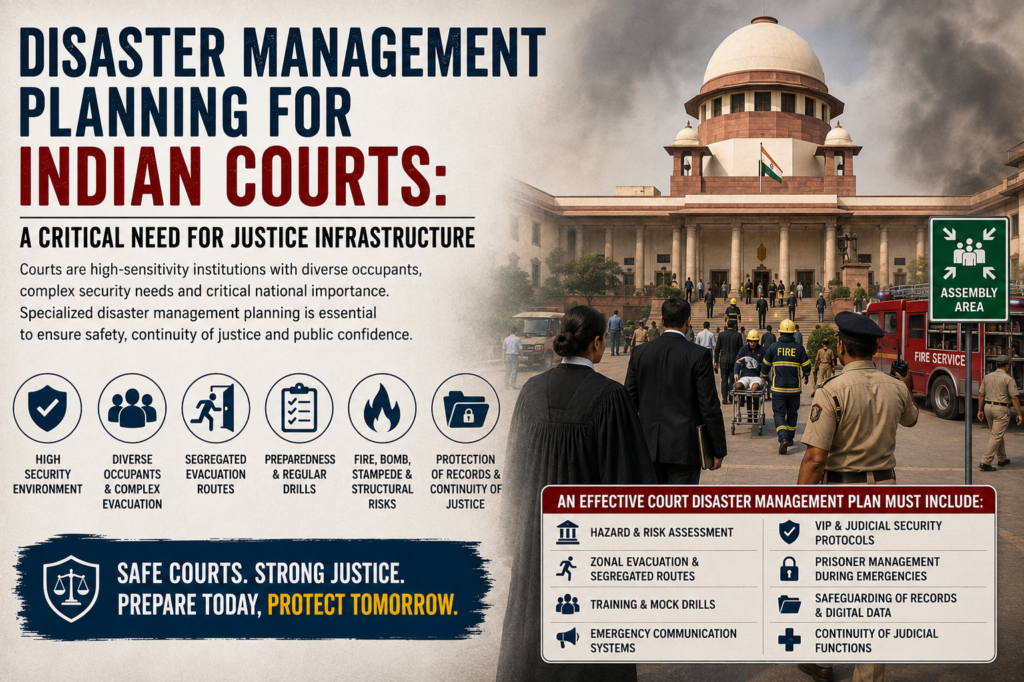
Disaster Management Planning for Indian Courts: A Critical Need for Justice Infrastructure
Introduction
Courts are among the most sensitive and strategically important public institutions in any democratic country. In India, court complexes are not merely administrative buildings; they are constitutional spaces where justice is delivered, liberty is protected, and the rule of law is upheld. Every day, courts host a unique combination of individuals from vastly different social, professional, and security backgrounds. Supreme Court judges, High Court judges, judicial officers, senior advocates, undertrial prisoners, police personnel, litigants, witnesses, journalists, court staff, and common citizens all operate simultaneously within the same infrastructure.
Unlike airports, hospitals, railway stations, or industrial facilities, courts function under a very different operational environment. A court complex is simultaneously a high-security zone, a public service center, a constitutional institution, and a controlled movement environment. Some of the country’s most respected individuals, including judges and senior lawyers, work within court premises. At the same time, some of the most notorious accused persons and organized crime suspects are also brought into the same premises under police custody.
This unique operational character makes disaster management planning for courts extremely complex. A conventional evacuation model, where everyone is directed toward a common exit or assembly point, may not work inside court premises. During emergencies such as fire incidents, bomb threats, stampedes, structural failures, terror attacks, earthquakes, or civil disturbances, courts require layered evacuation systems, segregated movement corridors, and differentiated emergency response protocols.
Despite the strategic importance of courts, most Indian court complexes still do not possess comprehensive and functional Disaster Management Plans (DMPs). Ironically, courts across India have repeatedly directed schools, malls, hospitals, factories, high-rise buildings, and public infrastructure facilities to develop emergency preparedness systems and disaster management mechanisms. However, judicial infrastructure itself has often remained outside systematic disaster preparedness frameworks.
In this context, the recent initiative by the Supreme Court of India to begin developing a Disaster Management Plan through the Central Public Works Department (CPWD) is a highly significant and welcome development. This initiative may become a landmark step toward institutional resilience in India’s justice delivery system.
This article explores why Indian courts require specialized disaster management systems, the risks associated with court infrastructure, the limitations of conventional evacuation planning, and the framework required for creating an effective court-specific Disaster Management Plan.
Why Courts Require Specialized Disaster Management Planning
- Courts Are High-Sensitivity Public Institutions
Court premises are fundamentally different from ordinary government buildings. The sensitivity level of courts is extremely high because judicial functioning directly affects constitutional governance, public confidence, and law enforcement.
Any disruption inside a court can have wide-ranging implications, including:
- Breakdown of judicial proceedings
- Public panic
- Security compromise
- Escape risks involving undertrial prisoners
- Threats to judges and witnesses
- Loss of sensitive legal records
- Media escalation and public unrest
- Delay in justice delivery
A disaster incident inside a court can quickly transform into a national security concern, especially in constitutional courts such as the Supreme Court of India and major High Courts.
- Diverse Occupancy Profile Creates Complex Evacuation Challenges
Unlike conventional office buildings where occupants belong to relatively similar operational groups, courts contain multiple categories of people with different security and evacuation requirements.
These include:
Judicial Officers
Judges require secure and protected evacuation routes. During emergencies, judges cannot be mixed with uncontrolled crowds due to security risks.
Senior Advocates and Legal Professionals
Senior lawyers and legal teams often work with sensitive constitutional, criminal, and commercial matters. Their evacuation zones require controlled movement systems.
Undertrial Prisoners and Accused Persons
Court lock-ups and prisoner transit areas create one of the most critical security vulnerabilities during disasters. If evacuation planning is not controlled, incidents such as prisoner escape, mob violence, or hostage situations may emerge.
Police and Security Personnel
Security agencies require operational continuity during disasters. Their role is not limited to self-evacuation; they must simultaneously manage crowd control, VIP protection, and incident response.
Litigants and Common Citizens
Thousands of ordinary citizens visit district courts and High Courts daily. Many are unfamiliar with court layouts and emergency procedures.
Vulnerable Occupants
Elderly litigants, differently-abled persons, children, and medical patients visiting legal aid clinics require assisted evacuation support.
Because of these mixed occupancy conditions, courts require zonal evacuation planning rather than a single evacuation strategy.
The Failure of Conventional Evacuation Models in Courts
Traditional evacuation systems used in malls or office buildings generally follow a “common exit” philosophy. Such systems assume that all occupants can safely move toward shared assembly areas.
This approach may fail inside courts for several reasons:
Security Conflict
Judges and prisoners cannot be evacuated through identical corridors.
Crowd Congestion
Court complexes often experience overcrowding, especially during high-profile hearings.
Sensitive Areas
Certain court sections contain:
- Evidence rooms
- Judicial records
- Digital servers
- Court archives
- Weapon deposit areas
- Prisoner holding cells
These areas require controlled shutdown procedures.
Multiple Threat Scenarios
An emergency inside a court may not always be accidental. Courts are exposed to:
- Terror threats
- Organized crime retaliation
- Political violence
- Protest escalations
- Bomb threats
- Targeted attacks
Therefore, evacuation plans must consider both disaster management and security management simultaneously.
Types of Disasters Relevant to Indian Courts
An effective court Disaster Management Plan must consider multiple categories of emergencies.
- Fire Incidents
Fire remains one of the biggest risks in Indian court complexes due to:
- Aging electrical systems
- Paper record storage
- Overloaded wiring
- Illegal temporary connections
- Poor housekeeping
- Lack of compartmentation
Several district courts still maintain massive physical archives without modern fire protection systems.
- Earthquakes
Many Indian courts operate from old structures located in seismic zones. Earthquake preparedness is especially important for courts in Delhi, Uttarakhand, Himachal Pradesh, Jammu & Kashmir, Northeast India, and other vulnerable regions.
- Bomb Threats and Terror Incidents
Courts dealing with organized crime, terrorism, or politically sensitive cases remain vulnerable to targeted attacks.
- Stampede and Crowd Panic
High-profile hearings can create dangerous crowd conditions.
- Structural Failure
Several district courts function from aging infrastructure with inadequate maintenance.
- Cyber and Data Infrastructure Failures
As courts increasingly digitize records and hearings, cyber risks and IT system failures also become part of disaster management planning.
Importance of Zonal Evacuation Strategy in Courts
A modern court Disaster Management Plan should adopt a “zonal evacuation framework.”
Instead of treating all occupants equally during evacuation, the court complex should be divided into operational and security zones.
Recommended Evacuation Zones
Zone 1 – Judicial Zone
This includes:
- Judges’ chambers
- Judges’ corridors
- Judicial conference rooms
- Reserved circulation paths
These areas should have:
- Protected exits
- Dedicated staircases
- Secure assembly zones
- Restricted access
Zone 2 – Advocate and Administrative Zone
This includes:
- Lawyer chambers
- Bar rooms
- Administrative offices
- Filing sections
These occupants may use controlled but less restricted evacuation systems.
Zone 3 – Public and Litigant Zone
This area usually experiences maximum crowd density.
Requirements include:
- Wider evacuation corridors
- Public announcement systems
- Emergency signage
- Crowd management teams
- Refuge areas
Zone 4 – Prisoner Transit and Lock-up Zone
This is the most sensitive evacuation area.
Key requirements:
- Controlled evacuation
- Police escort systems
- Segregated holding areas
- Lockdown capability
- Escape prevention measures
Zone 5 – Critical Infrastructure Zone
Includes:
- Record rooms
- Server rooms
- Electrical rooms
- Fire control rooms
- CCTV control rooms
These areas require both evacuation and continuity planning.
Key Components of a Court Disaster Management Plan
- Hazard Risk Vulnerability Assessment (HRVA)
Every court complex should first conduct a detailed Hazard Risk Vulnerability Assessment.
This assessment should identify:
- Fire hazards
- Structural risks
- Electrical vulnerabilities
- Crowd density patterns
- Security threats
- Medical emergency risks
- Flooding and waterlogging issues
- Court Layout Mapping
Detailed mapping should include:
- Courtrooms
- Emergency exits
- Staircases
- Refuge areas
- Assembly points
- Security barriers
- Fire-fighting equipment
- Medical response points
- Occupancy Analysis
The court administration must understand:
- Daily footfall
- Peak occupancy hours
- High-risk hearing schedules
- Visitor movement patterns
- Incident Command System (ICS)
A formal command structure must be established.
Typical structure:
- Incident Commander
- Security Coordinator
- Fire Response Team
- Medical Team
- Communication Officer
- Evacuation Wardens
- Communication Systems
Emergency communication should include:
- Public address systems
- Emergency alarms
- SMS alerts
- Wireless communication
- Digital control room integration
- Mock Drills
Mock drills should be conducted periodically to test the disaster management Plan and coordination among different team.
No Comments