 Collate Ideas For Community Radio Policy

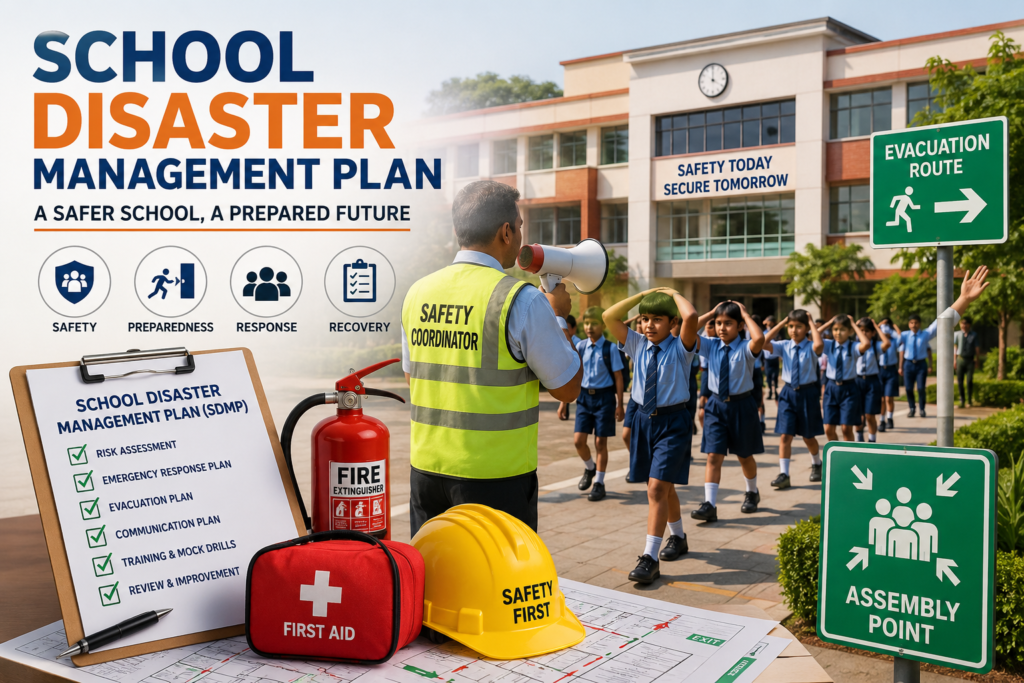
What is a School Disaster Management Plan (SDMP) and Why Every School in India Needs One
Schools are among the most sensitive public institutions in any country because they accommodate children, teachers, staff members, visitors, transport systems, laboratories, kitchens, electrical systems, and large daily gatherings. Children are considered one of the most vulnerable groups during disasters because they depend heavily on adults for guidance, evacuation, and emergency response. Therefore, safety and preparedness inside schools cannot be treated as optional administrative work. This is where a School Disaster Management Plan (SDMP) becomes critically important.
A School Disaster Management Plan (SDMP) is a structured safety and emergency preparedness framework developed to protect students, teachers, staff, and visitors from disasters and emergencies within a school campus. It is not merely a file prepared for compliance purposes. A proper SDMP is an operational life safety system that identifies hazards, assesses vulnerabilities, develops mitigation measures, establishes emergency response procedures, and creates evacuation mechanisms to protect human life during emergencies.
An SDMP generally covers multiple hazards that may affect schools. These include fire incidents, earthquakes, floods, storms, heatwaves, electrical accidents, laboratory incidents, structural failures, stampede situations, medical emergencies, and even security-related threats. The main objective of the plan is to reduce panic, improve preparedness, strengthen response capability, and ensure safe evacuation during emergencies.
The importance of school disaster preparedness became a major national concern after several tragic school disasters in India and abroad. One of the most heartbreaking incidents was the Kumbakonam School Fire tragedy in Tamil Nadu in 2004, where more than 90 children lost their lives after a fire rapidly spread through a school building with thatched roofing and inadequate evacuation systems. Many children became trapped because exits were blocked, classrooms were overcrowded, and emergency preparedness mechanisms were absent.
The tragedy exposed severe gaps in school safety systems, fire preparedness, evacuation planning, and regulatory enforcement. It demonstrated that disasters inside schools are not always caused only by fire itself, but by failure of evacuation and preparedness systems. The incident became a turning point in India’s approach toward school safety and eventually influenced stronger emphasis on Disaster Management Plans, fire safety systems, evacuation procedures, and mock drills in schools.
Another important lesson from school disasters globally is that panic, confusion, and lack of preparedness often increase casualties more than the original hazard. In many incidents, children and teachers were unaware of evacuation routes, emergency exits, or assembly procedures. This is why modern SDMPs focus heavily on practical preparedness, evacuation discipline, and regular mock drills rather than only documentation.
In India, School Disaster Management Plans are effectively mandatory under multiple legal and institutional frameworks related to disaster preparedness, fire safety, and child protection. The Disaster Management Act, 2005 emphasizes preparedness, mitigation, and institutional planning. The (NDMA) has issued School Safety Guidelines recommending that all schools develop disaster preparedness systems, evacuation procedures, and emergency response mechanisms.
The (CBSE) has also issued multiple directions related to fire safety, evacuation planning, and school preparedness. Many state governments, fire departments, and State Disaster Management Authorities (SDMAs) now expect schools to maintain Disaster Management Plans, Fire NOCs, evacuation maps, mock drill records, emergency contact systems, and safety committees.
Failure to maintain proper safety systems may lead to serious consequences. Schools may face cancellation of Fire NOCs, administrative penalties, closure notices, or legal liability in the event of accidents. In severe incidents involving injury or death, authorities may invoke criminal negligence provisions under applicable laws. Indian courts have repeatedly emphasized that institutions accommodating children carry a very high duty of care.
One of the most misunderstood aspects of Disaster Management Planning is the belief that a single consultant or individual can prepare a complete and effective Disaster Management Plan. In reality, no single person can independently prepare a comprehensive SDMP because disaster management is multidisciplinary in nature.
An effective School Disaster Management Plan requires a team of specialists from different domains. A fire safety expert understands fire load, evacuation bottlenecks, extinguisher systems, and emergency access. A structural expert identifies building vulnerabilities and unsafe infrastructure. An electrical expert evaluates electrical hazards and overload risks. Medical professionals advise on emergency medical response and first aid systems. Accessibility experts help develop inclusive evacuation systems for hearing-impaired, visually impaired, and differently-abled students. Disaster management professionals integrate all these components into a coordinated preparedness framework.
This is why professionally developed SDMPs are always team-based exercises rather than individual paperwork assignments. Schools should avoid purchasing generic template-based plans that are prepared without actual hazard assessment, site inspection, evacuation analysis, or technical review.
An important aspect of modern School Disaster Management Planning is inclusivity. Unfortunately, most emergency systems are still designed only for physically healthy individuals. For example, many schools install only traditional emergency sirens or bells assuming that every person can hear the warning signal. But what about a hearing-impaired student, teacher, or staff member? If the emergency communication system depends only on sound, then hearing-impaired persons may never receive the warning during a fire or emergency situation. Similarly, most evacuation maps, signage systems, and directional indicators are designed only for visually healthy persons. Very little attention is given to visually impaired individuals who may not be able to read printed evacuation routes or identify directional signage during emergencies.
A truly inclusive Disaster Management Plan must ensure that safety systems work for everyone, including hearing-impaired, visually impaired, wheelchair users, elderly persons, and people requiring assisted evacuation. Modern schools should therefore integrate multi-sensory emergency communication systems such as flashing strobe lights, vibration-based alerts, public display systems, tactile indicators, Braille signage, voice-assisted evacuation systems, and trained evacuation support teams. Inclusive preparedness is not merely a technical improvement; it is a life safety responsibility and a reflection of equal access and dignity during emergencies.
One of the most important components of a modern SDMP is evacuation planning. During a disaster, especially during fire incidents, evacuation becomes the most critical life-saving activity. Schools must have clearly identified evacuation routes, assembly areas, floor-wise evacuation maps, emergency exits, and emergency communication systems.
In recent years, self-glowing evacuation maps have emerged as one of the most effective safety tools in emergency preparedness. These maps are prepared using photoluminescent material that remains visible even during power failure, smoke conditions, or low visibility situations. During a fire incident, electricity often fails and smoke significantly reduces visibility. Under such conditions, ordinary printed evacuation maps become almost useless because occupants cannot read them in darkness or smoke-filled corridors.
Self-glowing evacuation maps continue to guide occupants toward exits even when visibility conditions deteriorate. This is especially important in schools because children often panic during emergencies. Clear glowing directional guidance can significantly improve evacuation speed and reduce confusion. Such systems are also more supportive for elderly persons, children, and partially visually impaired occupants during low-visibility emergencies.
Unfortunately, many institutions still use evacuation maps printed on ordinary non-fluorescent paper only for compliance purposes. Such maps may look attractive during inspections, but they may completely fail during real emergencies. In smoke conditions or power outages, non-fluorescent evacuation maps become difficult or impossible to read. This can delay evacuation, create confusion, increase panic, and potentially contribute to casualties.
Therefore, schools should treat evacuation mapping as a life safety system rather than decorative signage. Modern SDMPs should include:
- Self-glowing evacuation maps
- Directional evacuation signage
- Floor-wise evacuation routes
- Assembly area markings
- Accessibility-focused evacuation systems
- Emergency lighting systems
Another important component of an SDMP is the conduct of mock drills. Mock drills help students and teachers understand how to respond during emergencies. They improve evacuation discipline, reduce panic, test alarm systems, identify bottlenecks, and strengthen coordination among staff members.
Although the exact requirement may vary depending on local regulations, schools should ideally conduct at least two major evacuation drills every year along with periodic awareness and preparedness activities. Good practice also recommends fire drills, earthquake drills, inclusive evacuation drills, and tabletop emergency exercises for staff.
An SDMP also focuses heavily on hazard mitigation assistance. Hazard mitigation refers to measures taken to reduce or eliminate disaster risks before disasters occur. In schools, mitigation may include removing electrical hazards, widening exits, strengthening unsafe structures, improving fire safety systems, installing lightning protection systems, reducing overcrowding, and improving drainage systems.
Mitigation is considered one of the most important components of the Disaster Risk Reduction (DRR) cycle because prevention always reduces future losses.
Preparation of a School Disaster Management Plan generally begins with Hazard Risk Vulnerability Assessment (HRVA). This process identifies unsafe conditions inside and around the school. The school then develops resource mapping, emergency contact systems, Disaster Management Committees, Standard Operating Procedures (SOPs), evacuation plans, communication systems, and mock drill frameworks.
A professionally prepared SDMP should not remain limited to paperwork stored in an office cupboard. It should become part of everyday school operations. Teachers, staff members, students, transport teams, security guards, and support personnel should understand their roles during emergencies.
Today, disaster preparedness in schools is no longer only a fire safety requirement. It is increasingly viewed as part of child protection, institutional responsibility, public safety governance, and educational resilience.
In simple terms, a School Disaster Management Plan is a life safety framework designed to protect children and educational institutions from disasters through preparedness, planning, mitigation, evacuation, training, and coordinated emergency response.
For schools, preparedness is not merely compliance. It is a responsibility toward the protection of children’s lives. At Zone4solutions we have developed and operationalised more than 7500 SDMPs and today those schools are being called safe schools .
No Comments