 Collate Ideas For Community Radio Policy

Author: Dr. Nakul Kr. Tarun
Director, Zone4Solutions
Introduction
Delhi NCR has emerged as one of India’s largest industrial corridors, housing thousands of manufacturing units, warehouses, logistics parks, pharmaceuticals, engineering industries, food processing plants, chemical facilities, automobile suppliers, electronics manufacturers, and MSMEs. While industrial growth has accelerated economic development, it has also increased exposure to industrial disasters such as fires, explosions, chemical leaks, electrical failures, structural collapse, hazardous material spills, gas releases, and natural hazards.
The Disaster Management (Amendment) Act, 2025 has strengthened the emphasis on preparedness, institutional responsibility, and disaster risk reduction across sectors. At the same time, industrial units dealing with hazardous chemicals remain subject to on-site emergency planning under the Manufacture, Storage and Import of Hazardous Chemicals (MSIHC) Rules, 1989, while district administrations maintain off-site emergency plans for major industrial accidents.
Today, an Industrial Disaster Management Plan (IDMP) is no longer just a compliance document. It is a strategic business tool that protects people, assets, operations, reputation, and business continuity.
Why Every Industrial Unit Needs an IDMP
Many industries believe that installing fire extinguishers and obtaining statutory approvals is sufficient. However, major industrial accidents have repeatedly demonstrated that equipment and Fire NOC alone cannot prevent disasters.
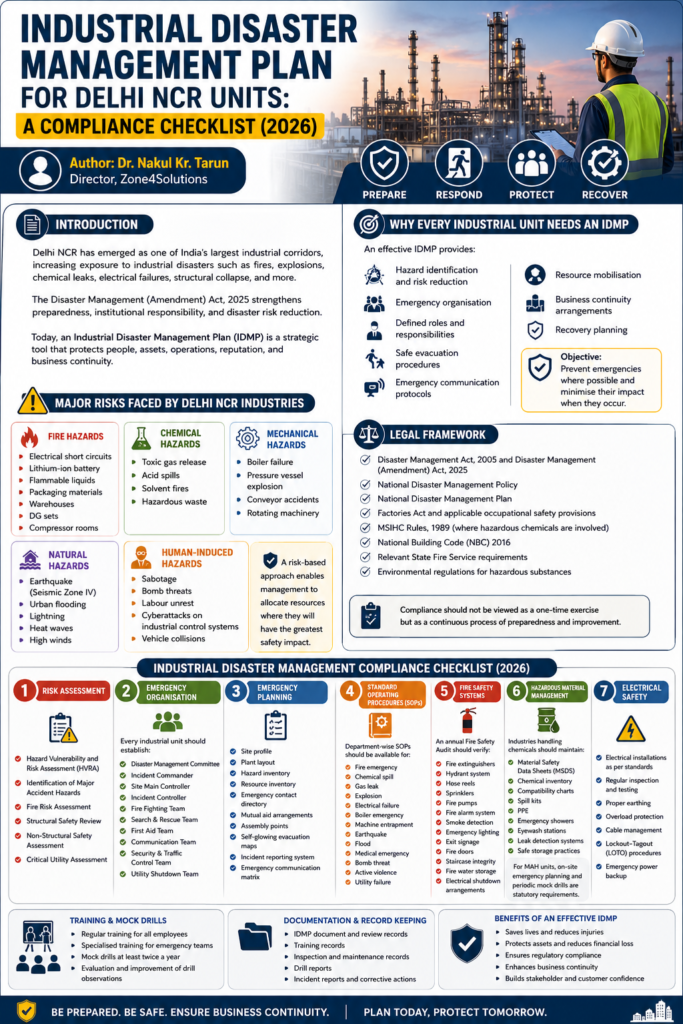
An effective Industrial Disaster Management Plan provides:
- Hazard identification and risk reduction
- Emergency organisation
- Defined roles and responsibilities
- Safe evacuation procedures
- Emergency communication protocols
- Resource mobilisation
- Business continuity arrangements
- Recovery planning
The objective is simple:
Prevent emergencies where possible and minimise their impact when they occur.
Major Risks Faced by Delhi NCR Industries
Every industrial facility has unique hazards. A Hazard Vulnerability and Risk Assessment (HVRA) should identify and prioritise these risks.
Typical hazards include:
Fire Hazards
- Electrical short circuits
- Lithium-ion battery
- Flammable liquids
- Packaging materials
- Warehouses
- DG sets
- Compressor rooms
Chemical Hazards
- Toxic gas release
- Acid spills
- Solvent fires
- Hazardous waste
Mechanical Hazards
- Boiler failure
- Pressure vessel explosion
- Conveyor accidents
- Rotating machinery
Natural Hazards
- Earthquake (Delhi lies in Seismic Zone IV)
- Urban flooding
- Lightning
- Heat waves
- High winds
Human-Induced Hazards
- Sabotage
- Bomb threats
- Labour unrest
- Cyberattacks on industrial control systems
- Vehicle collisions
A risk-based approach enables management to allocate resources where they will have the greatest safety impact.
Legal Framework
Industrial disaster preparedness is influenced by several laws and guidelines, including:
- Disaster Management Act, 2005 and the Disaster Management (Amendment) Act, 2025
- National Disaster Management Policy
- National Disaster Management Plan
- Factories Act and applicable occupational safety provisions
- MSIHC Rules, 1989 (where hazardous chemicals are involved)
- National Building Code (NBC) 2016
- Relevant State Fire Service requirements
- Environmental regulations for hazardous substances
Compliance should not be viewed as a one-time exercise but as a continuous process of preparedness and improvement.
Industrial Disaster Management Compliance Checklist (2026)
- Risk Assessment
✔ Hazard Vulnerability and Risk Assessment (HVRA)
✔ Identification of Major Accident Hazards
✔ Fire Risk Assessment
✔ Structural Safety Review
✔ Non-Structural Safety Assessment
✔ Critical Utility Assessment
- Emergency Organisation
Every industrial unit should establish:
✔ Disaster Management Committee
✔ Incident Commander
✔ Site Main Controller
✔ Incident Controller
✔ Fire Fighting Team
✔ Search & Rescue Team
✔ First Aid Team
✔ Communication Team
✔ Security & Traffic Control Team
✔ Utility Shutdown Team
- Emergency Planning
The Industrial Disaster Management Plan should include:
- Site profile
- Plant layout
- Hazard inventory
- Resource inventory
- Emergency contact directory
- Mutual aid arrangements
- Assembly points
- Self-glowing evacuation maps
- Incident reporting system
- Emergency communication matrix
- Standard Operating Procedures (SOPs)
Department-wise SOPs should be available for:
- Fire emergency
- Chemical spill
- Gas leak
- Explosion
- Electrical failure
- Boiler emergency
- Machine entrapment
- Earthquake
- Flood
- Medical emergency
- Bomb threat
- Active violence
- Utility failure
Clear SOPs reduce confusion and improve response time during incidents.
- Fire Safety Systems
An annual Fire Safety Audit should verify:
✔ Fire extinguishers
✔ Hydrant system
✔ Hose reels
✔ Sprinklers
✔ Fire pumps
✔ Fire alarm system
✔ Smoke detection
✔ Emergency lighting
✔ Exit signage
✔ Fire doors
✔ Staircase integrity
✔ Fire water storage
✔ Electrical shutdown arrangements
Regular inspection, testing and maintenance are essential to ensure that these systems perform as intended.
- Hazardous Material Management
Industries handling chemicals should maintain:
- Material Safety Data Sheets (MSDS)
- Chemical inventory
- Compatibility charts
- Spill kits
- PPE
- Emergency showers
- Eyewash stations
- Leak detection systems
- Safe storage practices
For Major Accident Hazard (MAH) units, on-site emergency planning and periodic mock drills are statutory requirements.
- Electrical Safety
Electrical failures remain one of the leading causes of industrial fires.
Industries should periodically inspect:
- LT and HT panels
- Transformers
- MCCs
- Earthing
- DG sets
- UPS rooms
- Cable trenches
- Thermal imaging (thermography)
Preventive maintenance significantly reduces fire risk.
- Self-Glowing Evacuation Maps
Traditional printed evacuation plans often become ineffective during smoke or power failures.
Photoluminescent (self-glowing) evacuation maps provide:
- Visibility without electricity
- Faster evacuation
- Reduced panic
- Clear escape routes
- Improved visitor guidance
They are particularly valuable in warehouses, factories, office buildings and industrial campuses.
- Training
The best emergency plan will fail if employees are not trained.
Training should cover:
- Fire extinguisher use
- Alarm procedures
- Safe evacuation
- First aid
- CPR
- Chemical spill response
- Incident reporting
- PPE
- Electrical safety
- Emergency communication
Training should include contractors, housekeeping staff and security personnel—not just permanent employees.
- Mock Drills
A Disaster Management Plan should be tested through regular exercises.
Typical scenarios include:
- Fire
- Chemical leak
- Gas release
- Explosion
- Earthquake
- Electrical failure
- Medical emergency
- Evacuation
- Warehouse fire
Each drill should conclude with:
- Debriefing
- Gap analysis
- Corrective Action Plan
- Management review
Common Gaps Found During Industrial Audits
Field audits frequently identify:
- Outdated Disaster Management Plans
- No Hazard Vulnerability Assessment
- Untrained emergency teams
- Missing SOPs
- Poor housekeeping
- Blocked emergency exits
- Missing evacuation maps
- Inadequate emergency lighting
- Expired fire extinguishers
- Incomplete maintenance records
- Lack of contractor training
- No business continuity planning
Addressing these gaps strengthens both safety and operational resilience.
Business Continuity: The Often-Missed Element
Industrial disasters affect more than safety; they disrupt production, supply chains, customer commitments and finances.
An Industrial Disaster Management Plan should therefore include:
- Critical process identification
- Backup utilities
- IT recovery
- Vendor continuity
- Alternate production arrangements
- Crisis communication
- Recovery priorities
Preparedness reduces downtime and supports faster recovery after an incident.
Role of Zone4Solutions
Zone4Solutions supports industries across Delhi NCR through integrated disaster preparedness services, including:
- Industrial Disaster Management Plans
- Hazard Vulnerability & Risk Assessment (HVRA)
- Rapid Visual Assessment (RVA)
- Fire Safety Audits
- Electrical Safety Assessments
- Emergency SOP development
- Incident Command System implementation
- Self-glowing evacuation mapping
- Staff training
- Tabletop exercises
- Mock drills
- Business continuity support
The focus is not only on documentation but on creating a practical emergency management system that employees can implement effectively.
Conclusion
Industrial safety is evolving from a compliance-driven approach to a resilience-driven approach. Regulatory expectations, stakeholder awareness and operational risks all point in the same direction: industries must be prepared before an emergency occurs.
A comprehensive Industrial Disaster Management Plan integrates risk assessment, fire safety, emergency organisation, training, communication and recovery planning into one operational framework. It helps protect lives, ensures business continuity, strengthens regulatory compliance and builds confidence among employees, customers and regulators.
For industrial units in Delhi NCR, preparedness is no longer optional. It is a strategic investment in safety, resilience and sustainable business operations.
Industrial Disaster Management Compliance Checklist (Quick Reference)
□ Hazard Vulnerability & Risk Assessment (HVRA)
□ Industrial Disaster Management Plan (IDMP)
□ Disaster Management Committee
□ Incident Command Structure
□ Department-wise SOPs
□ Fire Safety Audit
□ Electrical Safety Assessment
□ Hazardous Chemical Management
□ Emergency Resource Inventory
□ Emergency Contact Directory
□ Self-Glowing Evacuation Maps
□ Staff Training Programme
□ Mock Drill Programme
□ Business Continuity Plan
□ Annual Review and Plan Update
A well-maintained Industrial Disaster Management Plan is not merely a compliance document; it is a practical roadmap that enables an organisation to respond quickly, protect its workforce, minimise losses and recover efficiently from emergencies.
No Comments