 Collate Ideas For Community Radio Policy

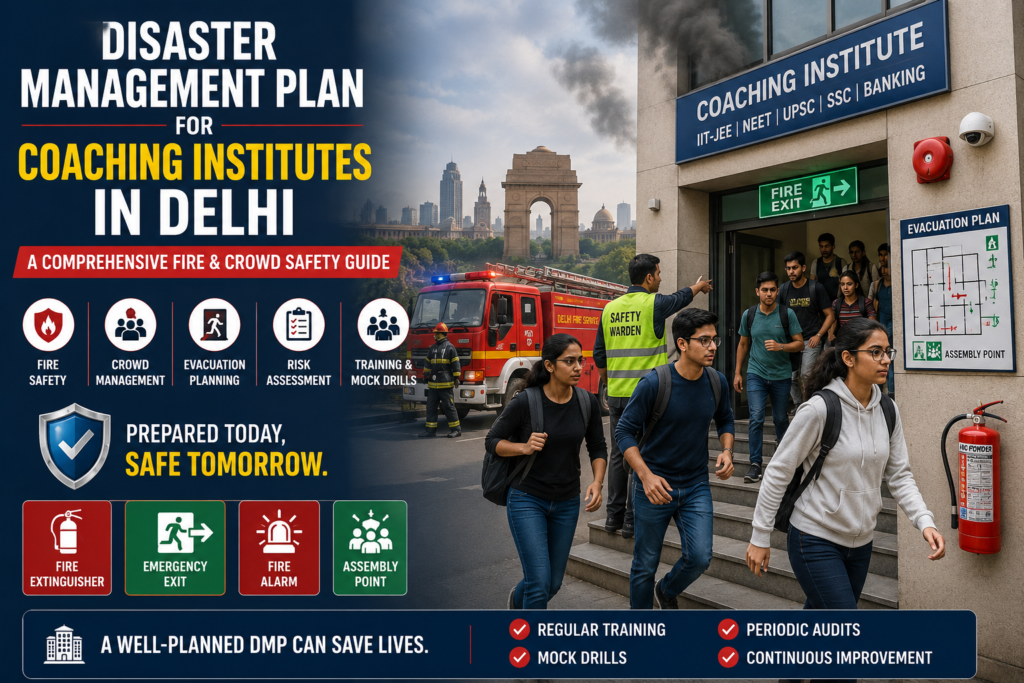
Lessons from Recent Tragedies and the Need for Operational Preparedness
By Dr. Nakul Kr. Tarun
Director, Zone4 Disaster Solutions Pvt. Ltd.
Introduction
Delhi has become one of India’s largest educational hubs, with thousands of coaching institutes preparing students for UPSC, IIT-JEE, NEET, SSC, Banking, CUET and numerous competitive examinations. Every day, lakhs of students attend classes in multi-storey commercial buildings, rented premises, shopping complexes, and converted residential buildings.
While coaching institutes have transformed the education landscape, they have also created new challenges in terms of fire safety, crowd management, emergency evacuation, and disaster preparedness.
Recent incidents have highlighted a critical reality: many coaching institutes are located in buildings never designed to accommodate such high occupant loads. Narrow staircases, blocked exits, overcrowded classrooms, inadequate ventilation, and the absence of Disaster Management Plans (DMPs) significantly increase the risk to students and staff.
The purpose of this article is to explain why every coaching institute in Delhi should develop and operationalize a Disaster Management Plan (DMP), supported by regular training, fire safety audits, and mock drills.
Why Coaching Institutes Are High-Risk Occupancies
Unlike schools and colleges, coaching institutes often operate in leased commercial spaces where safety receives less attention than classroom capacity. A single building may accommodate hundreds of students across multiple coaching centres, creating complex evacuation challenges.
Common risk factors include:
- High occupant density in classrooms.
- Limited means of egress.
- Basements used for classrooms or libraries.
- Heavy electrical loads due to air conditioning and electronic equipment.
- Temporary partitions altering escape routes.
- Students unfamiliar with emergency exits.
- Peak occupancy during evenings and examination seasons.
In an emergency, these factors can quickly lead to panic, congestion, and delayed evacuation.
Case Study 1: Rajendra Nagar Basement Flooding (2024)
The deaths of civil services aspirants in a flooded coaching centre basement in Old Rajendra Nagar shocked the nation. Water entered the basement rapidly, trapping students who had little time to escape.
The incident demonstrated that disaster risk extends beyond fire. Flooding, structural safety, electrical hazards, and emergency access are equally important.
Key Lessons:
- Basements require hazard-specific risk assessments.
- Emergency exits must remain unobstructed.
- Weather warnings should trigger operational decisions, including temporary closure.
- Disaster Management Plans must address multiple hazards, not just fire.
Case Study 2: Lucknow Coaching Institute Fire
A fire at a coaching institute in Lucknow highlighted deficiencies common across educational occupancies:
- Congested staircases.
- Inadequate emergency exits.
- Limited staff preparedness.
- Students unaware of evacuation procedures.
Although many students escaped, the incident showed how quickly panic can develop in crowded educational buildings.
Lesson: Safe evacuation depends as much on trained staff and clear procedures as on fire protection equipment.
Case Study 3: Delhi Hotel Fires and Their Relevance
While hotel fires involve different occupancies, they offer valuable lessons for coaching institutes.
Following the Malviya Nagar hotel fire, authorities began issuing notices under the Disaster Management Act requiring institutions to rectify deficiencies such as blocked exits, non-functional fire systems, missing Disaster Management Plans, and poor housekeeping.
These enforcement measures demonstrate a shift toward preventive disaster management and reinforce that preparedness must become part of day-to-day operations.
Legal Framework Applicable to Coaching Institutes
Coaching institutes in Delhi should comply with:
- Disaster Management Act, 2005.
- National Building Code of India (NBC 2016).
- Delhi Fire Service Act and Rules.
- Delhi Building Bye-Laws.
- NDMA Guidelines on School Safety (where relevant principles apply).
- Occupational safety requirements for commercial establishments.
A Disaster Management Plan also supports compliance during inspections by district authorities.
What Is a Disaster Management Plan?
A Disaster Management Plan is more than a document prepared to satisfy regulatory requirements.
It is a practical system that enables an organization to:
- Identify hazards.
- Assess risks.
- Allocate responsibilities.
- Coordinate emergency response.
- Protect life and property.
- Recover quickly after an incident.
The plan should be a living document, updated regularly and tested through exercises.
Essential Components of a Coaching Institute DMP
Every DMP should include:
- Hazard Vulnerability Risk Assessment (HVRA).
- Building profile and occupancy details.
- Emergency contact directory.
- Resource inventory.
- Incident Response Team structure.
- Standard Operating Procedures (SOPs).
- Evacuation routes and assembly points.
- Procedures for students with disabilities.
- Communication protocols.
- Business continuity measures.
Fire Safety Requirements
Common fire hazards in coaching institutes include:
- Overloaded electrical circuits.
- Poor cable management.
- Inverter and battery installations.
- Storage of combustible materials.
- Pantry and LPG use.
- Blocked staircases.
- Locked exits.
Every institute should ensure:
- Fire extinguishers are appropriate and maintained.
- Hydrants and hose reels are functional where required.
- Exit signage is illuminated.
- Emergency lighting operates during power failure.
- Escape routes remain unobstructed.
Crowd Management
Student movement should be planned to avoid congestion.
Important measures include:
- Staggered class timings.
- Maximum occupancy limits for classrooms.
- Clear circulation paths.
- Trained floor wardens.
- Visitor management procedures.
- Queue management during examinations.
Evacuation Planning
Evacuation plans should identify:
- Primary and secondary exits.
- Refuge areas where applicable.
- Assembly points.
- Responsibilities for attendance verification.
- Procedures for assisting injured persons.
Photoluminescent (self-glowing) evacuation maps are especially useful during smoke conditions and power failures. It helps both parties. The first who are required to evacuate, and the second is the responding agency, which will understand the layout of the building to make their response effective.
Training and Mock Drills
A Disaster Management Plan becomes effective only when people know how to implement it.
Training should cover:
- Fire safety.
- First aid for the injured.
- Search and rescue.
- Crowd management.
- Communication during emergencies.
Mock drills should be conducted at least four times in a year to identify weaknesses and improve preparedness.
Role of Management
The management of coaching institutes should:
- Nominate a Disaster Management Coordinator.
- Constitute an Incident Response Team.
- Ensure regular maintenance of fire systems.
- Keep records of inspections, training, and drills.
- Foster a culture where safety is everyone’s responsibility.
Benefits of a Disaster Management Plan
Operationalizing a DMP helps coaching institutes:
- Save lives during emergencies.
- Improve confidence among students and parents.
- Enhance regulatory compliance.
- Reduce legal liability.
- Minimize business disruption.
- Build institutional resilience.
Conclusion
The recent tragedies in educational and commercial occupancies have demonstrated that preparedness cannot be an afterthought. The first few minutes of an emergency determine whether people survive until professional responders arrive.
A coaching institute may have modern classrooms and excellent faculty, but without a functional Disaster Management Plan, trained staff, and regular mock drills, it remains vulnerable to avoidable disasters.
The objective should not merely be to comply with regulations but to create a safe learning environment where every student and staff member knows what to do when an emergency occurs.
As we often say in disaster management:
“The best disaster response is the one that begins long before the disaster.”
By investing in risk assessment, operational planning, training, and periodic drills, coaching institutes in Delhi can transform from being merely compliant to becoming truly resilient.
No Comments