 Collate Ideas For Community Radio Policy

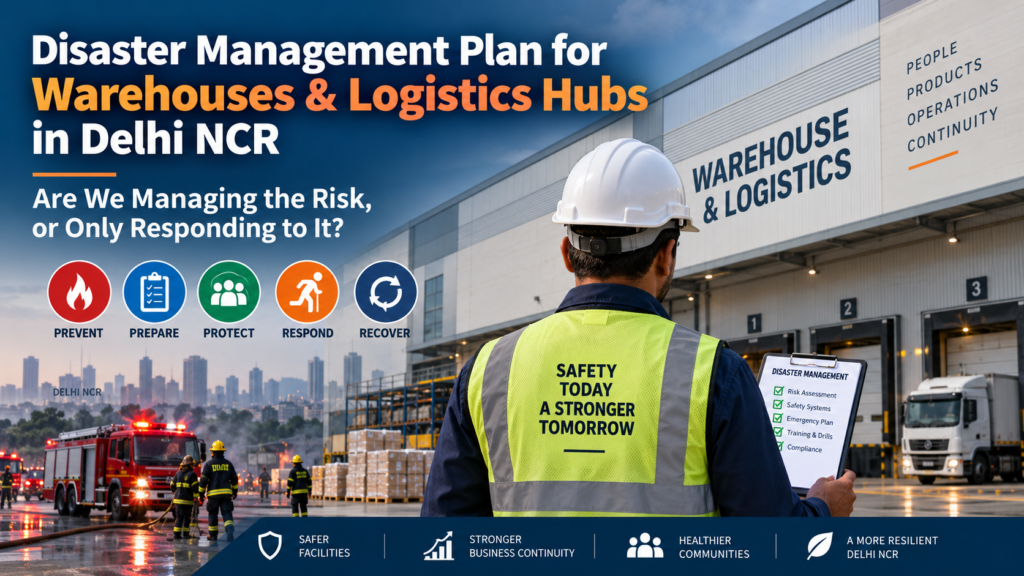
“Disaster Management Plan for Warehouses & Logistics Hubs in Delhi NCR”
One point I would slightly qualify in the article: rather than stating as a verified fact that “most warehouses in Delhi NCR are unauthorised”, I would frame it as a serious sector-wide concern that needs data-based verification. I could not find an authoritative NCR-wide dataset establishing that the majority are unsanctioned. However, official planning documents do recognise non-conforming/unplanned industrial areas, and Delhi Fire Service explicitly links fire-safety approval to the building-plan/sanctioning framework.
Disaster Management Plan for Warehouses & Logistics Hubs in Delhi NCR
Are We Managing the Risk, or Only Responding to It?
Delhi NCR is rapidly becoming one of India’s most important warehousing and logistics regions.
From e-commerce fulfilment centres and cold chains to pharmaceutical warehouses, automotive storage, FMCG distribution centres, third-party logistics facilities and last-mile delivery hubs, thousands of workers enter these facilities every day.
But there is a fundamental question we need to ask:
Are our warehouses actually disaster-resilient, or have we simply become better at responding when something goes wrong?
This question becomes particularly important in Delhi NCR because warehouses and logistics operations are increasingly being established in existing industrial sheds, converted buildings, peri-urban areas and locations where the original building approval, land use, actual occupancy and present-day use may not always match.
And this creates a dangerous gap between what the building is legally approved for and what the building is actually being used for.
1. A Warehouse Is Not Just a Building
A modern warehouse is a complex risk environment.
It may contain:
Large quantities of combustible material
Packaging material and plastics
Pallets
Electrical equipment
Battery charging areas
Diesel generators
Refrigeration systems
LPG or other fuels
Chemicals and cleaning agents
EV batteries
Forklifts
Conveyor systems
Automated storage systems
High-rack storage
Cold-storage systems
Hundreds of workers
Loading and unloading vehicles
A relatively small fire can therefore develop into a large-scale industrial emergency within minutes. The risk becomes even greater when a warehouse operates inside a building that was not originally designed, sanctioned or engineered for the present occupancy and storage load.
2. The Elephant in the Room: Building Approval
This is perhaps the most uncomfortable question in warehouse safety.
How many warehouses operating today actually have a building sanction corresponding to their present use, built-up area, height, layout and occupancy?
Delhi NCR has witnessed enormous growth of logistics infrastructure.
Warehouses have emerged around:
Delhi
Gurugram
Manesar
Faridabad
Ghaziabad
Noida
Greater Noida
Sonipat
Bahadurgarh
Kundli
Bhiwadi
other peripheral logistics corridors.
At the same time, Delhi and NCR planning authorities have historically dealt with non-conforming and unplanned industrial areas. DDA, for example, has specific regulations dealing with redevelopment of industrial concentrations in non-conforming/unplanned areas. (MCD Online)
The NCR’s own regional planning vision recognises logistics hubs, warehouses and related infrastructure as a major component of the region’s future economic development. (NCRPB)
This creates a fundamental policy challenge:
We cannot build a world-class logistics economy on a weak building-safety foundation.
3. Building Sanction and Fire Safety Are Connected
This distinction needs to be understood clearly.
In Delhi, the Delhi Fire Service states that building plans are normally submitted through or referred by the concerned building-sanctioning authority such as MCD, DDA, NDMC, Delhi Cantonment Board or DUSIB. Fire-safety plans are linked to the approved building parameters and applicable UBBL/NBC requirements. (Delhi Fire Service)
More importantly, storage buildings having a covered area exceeding 250 sq. m. fall within the categories requiring Fire Service NOC/FSC under the specified rules. (Delhi Fire Service)
The process essentially has two stages:
Before construction:
Building plans are approved and fire-safety recommendations are issued.
After construction:
The installed fire and life-safety measures are inspected before occupancy and the Fire Safety Certificate is issued where applicable. (Delhi Fire Service)
Therefore, fire safety cannot realistically be looked at independently from the building itself.
4. But Here Is the Contradiction
This is where the debate becomes interesting.
Suppose a warehouse operates from a building whose construction or use does not have the required sanction.
Suppose, because of this, the occupier cannot obtain the normal Fire Safety Certificate.
Now imagine that a fire breaks out.
Will the fire service say:
“This building is unauthorised; therefore, we will not respond”?
Obviously not.
The Fire Service will respond.
Because emergency services cannot stand outside a burning building and ask whether the building has a sanctioned plan before rescuing people.
And that is exactly where the policy contradiction emerges.
The regulatory system may say:
“This building cannot receive the required approval.”
The emergency-response system says:
“If there is a fire, we will still come and save lives.”
Both positions are understandable.
But together they reveal a major gap:
If the State knows that a building is operating outside the approval framework, but workers continue to occupy it every day, what mechanism ensures that the people inside are protected until the legal issue is resolved?
This is the question we need to answer.
5. Emergency Response Cannot Be Our Safety Strategy
A fire engine arriving at a warehouse is response.
It is not risk reduction.
A rescue operation after a warehouse fire cannot compensate for:
inadequate exits,
blocked escape routes,
poor electrical installations,
absence of compartmentation,
inadequate fire detection,
insufficient water supply,
inappropriate storage height,
unsafe battery charging,
lack of emergency lighting,
poor housekeeping,
absence of trained staff,
inadequate structural stability,
or an unsuitable building.
We need to move from:
“Fire brigade will come if something happens.”
to:
“We have reduced the probability and consequences of something happening.”
6. The Real Risk: Occupancy Mismatch
One of the most important issues for warehouse operators is occupancy mismatch.
A building may originally have been designed for one purpose.
But today it may be functioning as:
a warehouse,
distribution centre,
fulfilment centre,
cold storage,
manufacturing-support facility,
packaging centre,
battery storage area,
or mixed-use logistics hub.
The risk profile changes dramatically.
The Delhi Fire Service itself identifies occupancy, building height and floor area as important parameters for determining fire-safety requirements. (Delhi Fire Service)
Therefore, a warehouse should not be assessed simply by asking:
“Do we have fire extinguishers?”
The correct question is:
“Is this building, in its present configuration and occupancy, capable of safely supporting the activity taking place inside it?”
7. What Should a Warehouse Disaster Management Plan Cover?
A proper Warehouse & Logistics Hub Disaster Management Plan (W-LHDMP) should go far beyond a fire evacuation plan.
It should include at least the following:
Hazard Identification & Risk Assessment
Identify risks from:
Fire
Explosion
Electrical faults
Chemical leakage
LPG
Battery charging
EV batteries
Refrigeration systems
Structural failure
Earthquake
Flood/waterlogging
Extreme heat
Storm/high winds
Lightning
Hazardous material
Vehicle accidents
Forklift accidents
Crowd/worker emergencies
Security incidents
Sabotage
Business interruption
8. Structural Safety Must Be Part of the Plan
Warehouses frequently use large-span structures, sheds, mezzanines, racks and heavy storage systems.
Therefore the DMP should examine:
Structural stability
Age of structure
Roof condition
Columns and beams
Mezzanine floors
Storage-rack loading
Floor loading
Unauthorized additions
Alterations
Water seepage
Corrosion
Settlement
Cracks and visible distress.
Where there is doubt about structural adequacy, a competent structural engineer should undertake a structural assessment/stability certification.
A disaster plan cannot compensate for an unsafe structure.
9. Fire Risk Assessment
The fire assessment should examine:
Fire Load
Packaging
Plastics
Paper
Textiles
Chemicals
Pallets
Stored goods
Battery inventory.
Fire Detection
Smoke detectors
Heat detectors
Beam detectors
Manual call points
Alarm panels.
Fire Suppression
Hydrant system
Sprinklers
Hose reels
Fire pumps
Fire-water storage
Portable extinguishers.
Delhi Fire Service specifies that sprinkler design and installation should follow the applicable requirements, including IS 15105. (Delhi Fire Service)
Smoke Management
Large warehouses can rapidly accumulate smoke, making visibility and evacuation extremely difficult.
Smoke management therefore needs to be considered along with fire detection and suppression.
10. High-Rack Storage: A Special Risk
Modern logistics centres increasingly use high-rack storage.
This changes the fire scenario.
A small fire at floor level can develop into a three-dimensional fire involving multiple storage levels.
Therefore the Disaster Management Plan should address:
Rack height
Aisle width
Storage configuration
Sprinkler compatibility
Commodity classification
Fire separation
Access for firefighters
Emergency shutdown
Evacuation routes.
11. Battery Charging Areas Need Special Attention
This is an emerging risk.
Warehouses increasingly operate:
Electric forklifts
EVs
Battery-operated material-handling equipment
Lithium-ion battery systems.
Battery charging should therefore have dedicated controls for:
Location
Ventilation
Electrical protection
Charging procedures
Damaged batteries
Thermal runaway
Emergency isolation
Fire detection
Emergency response.
A warehouse DMP written five years ago may not adequately address today’s battery-related risks.
12. The First 10 Minutes Matter
Every warehouse should have a clearly defined emergency action plan.
Minute 0–1
Detect and raise alarm.
Minute 1–3
Stop operations and isolate the hazard where safe.
Minute 3–5
Initiate evacuation and inform emergency services.
Minute 5–10
Account for employees and guide firefighters to the incident location.
This requires trained personnel.
A fire alarm without trained people is simply a noise.
13. Warehouse Emergency Response Structure
Every large logistics facility should establish an Incident Response Team.
Typical responsibilities may include:
Incident Commander
Fire & Emergency Team
Evacuation Team
First Aid/Medical Team
Security & Access Control Team
Utility Isolation Team
Communication Team
Search & Accountability Team
Logistics/Resource Team
The organisation should also establish clear succession arrangements for shift operations.
Because a warehouse operates 24×7, a plan that works only during the day shift is not a Disaster Management Plan.
14. The 24×7 Problem
This is one of the biggest weaknesses in warehouse emergency preparedness.
Many facilities have:
senior management during daytime,
supervisors during evening,
minimum manpower at night.
But disasters do not respect office hours.
Therefore the DMP must answer:
Who is the Incident Commander at 2:30 AM?
Who will operate the fire pump?
Who will shut down electricity?
Who will open the gates for firefighters?
Who will account for contract workers?
Who will provide the site plan to the fire service?
If these questions cannot be answered immediately, the facility is not operationally prepared.
15. Contract Workers Cannot Be Forgotten
Warehouses often depend heavily on:
contractual labour,
security guards,
drivers,
housekeeping staff,
loading/unloading workers,
temporary manpower.
They may be the people most unfamiliar with the building.
Therefore:
Training cannot be limited to permanent employees.
Every shift should have trained emergency personnel.
16. Emergency Maps Should Be Visible
Large logistics facilities should have clearly displayed:
Self-Glowing / Photoluminescent Evacuation Maps
showing:
“You Are Here”
Primary exit
Alternate exit
Emergency exits
Staircases
Fire extinguishers
Hydrants
Fire alarm points
Assembly area
First-aid point
Emergency equipment.
During smoke-filled conditions or power failure, conventional signage may become difficult to see.
17. What Happens When the Building Is Not Sanctioned?
This is the difficult part.
We should not pretend that an unauthorised or non-sanctioned building becomes legally compliant merely because somebody prepares a Disaster Management Plan.
A DMP does not regularise a building.
A Fire Audit does not regularise a building.
A consultant’s certificate does not regularise a building.
A mock drill does not regularise a building.
The legal and planning status must ultimately be addressed by the competent authority.
But there is another equally important principle:
The absence of building approval does not make the people working inside the building disposable.
Therefore, where operations continue while regulatory issues are being resolved, authorities, owners and occupiers should consider risk-based interim safety measures, subject to the applicable legal framework.
These could include:
structural assessment,
electrical safety audit,
fire risk assessment,
emergency exits,
detection and alarm,
firefighting systems,
emergency lighting,
evacuation maps,
trained emergency teams,
mock drills,
emergency access for fire vehicles,
fire-water availability,
housekeeping,
storage controls,
battery safety,
emergency communication.
This should be viewed as risk reduction, not legal regularisation.
18. We Need a Delhi NCR Warehouse Safety Census
This is perhaps the biggest policy recommendation.
Before asking whether every warehouse has a Fire Safety Certificate, we should first understand the actual situation.
Create a database of warehouses and logistics facilities across Delhi NCR containing:
Location
Land-use status
Building sanction status
Occupancy
Built-up area
Height
Structural condition
Fire NOC/FSC status
Fire protection systems
Storage commodity
Fire load
Emergency access
Water availability
Worker population
Contract labour
Battery charging
Hazardous material
Disaster Management Plan
Mock-drill status
Emergency response capability
Only then can we answer the real question:
How much risk are we actually carrying?
19. Don’t Create Two Categories of Safety
There is a danger of creating two extreme positions.
Category 1:
“The building is sanctioned, therefore it is safe.”
Wrong.
Approval does not guarantee operational safety.
Category 2:
“The building is not sanctioned, therefore nothing can be done.”
Also dangerous.
Workers continue to enter the building every day.
Therefore, the right approach is:
Legal Compliance + Risk Reduction + Emergency Preparedness
All three are necessary.
20. From Fire NOC to Disaster Resilience
We need to change the way warehouse safety is discussed.
Instead of asking only:
“Does the warehouse have a Fire NOC?”
we should ask:
Is the building legally approved?
Is the present occupancy authorised?
Is the structure stable?
Is the fire load understood?
Are the fire systems adequate?
Can workers evacuate safely?
Can firefighters reach the building?
Are emergency teams trained?
Has the plan been tested?
What happens during a power failure?
What happens during flooding?
What happens during an earthquake?
What happens if the primary exit is blocked?
What happens at night?
What happens if the fire involves lithium batteries or hazardous materials?
That is a Disaster Management Plan.
Not just a Fire Safety Certificate.
21. The Bigger Delhi NCR Question
Delhi NCR wants to become one of India’s largest logistics and distribution centres.
The region’s planning documents themselves recognise logistics hubs, warehouses and related infrastructure as strategically important. (NCRPB)
But economic growth and safety cannot operate on separate tracks.
If warehouses are established faster than the regulatory system can assess them, we create a growing risk inventory.
And once that inventory becomes too large, enforcement alone becomes difficult.
The answer is not simply:
Seal everything.
Nor is it:
Ignore everything.
The answer should be:
Identify. Assess. Classify. Mitigate. Regularise where possible. Relocate where necessary. And prepare everyone for emergencies in the meantime.
22. The Fundamental Question
There is a very uncomfortable question that Delhi NCR should ask:
If a building is not legally sanctioned and therefore cannot obtain the normal Fire Safety Certificate, but hundreds of workers continue to work inside it every day — who is responsible for reducing the disaster risk to those workers?
The Fire Service?
The municipal authority?
The development authority?
The warehouse owner?
The occupier?
The logistics company?
The landlord?
The labour department?
The insurance company?
The answer cannot be:
“Nobody, because the building is unauthorised.”
Because the people inside it are real.
And when disaster strikes, the emergency response system will still be expected to save them.
Conclusion
Delhi NCR does not merely need more warehouses.
It needs safe, compliant and disaster-resilient warehouses.
We need to stop thinking of warehouse safety as an issue that begins with a fire extinguisher and ends with a Fire NOC.
The real chain is:
Land Use → Building Approval → Structural Safety → Occupancy → Fire Safety → Storage Risk → Worker Safety → Emergency Preparedness → Response → Business Continuity
Break any link in this chain and the entire system becomes vulnerable.
And perhaps the most important lesson is this:
A Fire Service responding to an emergency is not evidence that the building was safe. It is evidence that the emergency response system is doing its job.
Our objective should be much higher:
Don’t wait for the fire service to save people. Build warehouses where people are less likely to need saving in the first place.
Disaster Management is not about preparing for the fire engine.
It is about reducing the chance that the fire engine will ever be needed.
Stay Safe. Stay Prepared. Zone4Solutions
No Comments