 Collate Ideas For Community Radio Policy


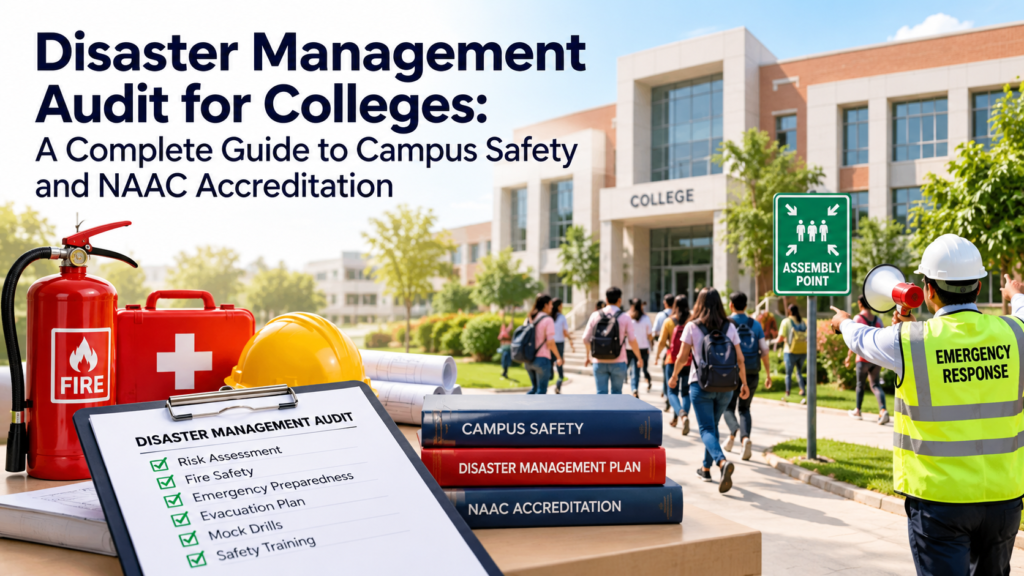
A safer campus begins with a professional risk assessment, a practical Disaster Management Plan and regular testing of emergency preparedness.
Colleges and universities bring together hundreds or thousands of students, faculty members, administrative staff, visitors and service personnel every day. Academic buildings, laboratories, libraries, auditoriums, hostels, cafeterias, workshops and sports facilities present different types of risks.
A fire, earthquake, electrical incident, laboratory accident, structural failure or crowd emergency can put lives at risk if the institution is not adequately prepared.
Having fire extinguishers, emergency exits or a Disaster Management Plan (DMP) on paper does not automatically mean that a campus is safe. The real question is whether the institution can identify its risks, respond effectively to an emergency and evacuate occupants safely when necessary.
A professional Disaster Management Audit of a college helps assess these arrangements, identify gaps and recommend practical corrective measures. It can also help institutions organise evidence relating to safety, emergency preparedness and institutional risk management for the applicable National Assessment and Accreditation Council (NAAC) assessment framework.
- What Is a Disaster Management Audit?
A Disaster Management Audit systematically assesses an institution’s hazards, vulnerabilities, emergency preparedness, response arrangements, and disaster risk reduction measures.
Its purpose is to determine whether the institution has suitable arrangements to prevent avoidable incidents, reduce their consequences and respond effectively when an emergency occurs.
A comprehensive audit examines both the campus’s physical safety and its operational preparedness.
The audit may cover:
- Identification of campus-specific hazards and vulnerabilities.
- Review of fire and life-safety arrangements.
- Assessment of emergency exits, evacuation routes and assembly points.
- Review of the existing Disaster Management Plan and emergency Standard Operating Procedures (SOPs).
- Assessment of emergency teams, staff training and mock drills.
- Review of arrangements for students and visitors with disabilities.
- Verification of relevant safety records, inspection reports and corrective actions.
- Recommendations for improving emergency preparedness and institutional resilience.
The objective is not merely to prepare a report. It is to help the college develop a safer campus and establish a system for continuously improving preparedness.
- Why Do Colleges Need a Disaster Management Audit?
Educational institutions have a special responsibility because many occupants may be unfamiliar with emergency procedures, buildings or evacuation routes.
In a residential college or university, students may be present in hostels, dining areas, laboratories and other facilities beyond normal academic hours. Large gatherings during examinations, festivals, cultural programmes and convocations can create additional evacuation and crowd-management challenges.
Common campus hazards include:
Fire and electrical hazards: Overloaded circuits, faulty wiring, unsafe electrical installations, combustible materials, laboratories, kitchens and inadequate emergency arrangements.
Structural and non-structural hazards: Deteriorating buildings, falling fixtures, unsecured equipment and objects that may become dangerous during an earthquake.
Laboratory and chemical risks: Improper storage or handling of chemicals, gases, flammable substances and other hazardous materials.
Crowd emergencies: Congestion at staircases, narrow passages, auditorium exits, entrances and assembly areas during major events.
Natural hazards: Earthquakes, urban flooding, lightning, heatwaves, severe weather and other hazards relevant to the campus location.
Operational gaps: Unclear emergency responsibilities, inadequate training, outdated evacuation maps, inaccessible exits and untested emergency procedures.
A Disaster Management Audit helps identify these vulnerabilities before an emergency exposes them.
- How Is a Disaster Management Audit Relevant to NAAC Accreditation?
The National Assessment and Accreditation Council assesses higher education institutions through its applicable accreditation framework. Institutional arrangements concerning safety, emergency preparedness, infrastructure, risk management and related practices may be relevant to the criteria or supporting evidence applicable to a particular institution and assessment cycle.
A Disaster Management Audit can help a college document its approach to identifying risks, improving campus safety and preparing its community for emergencies.
It may support institutional documentation through:
- A documented assessment of campus hazards and vulnerabilities.
- An updated, site-specific Disaster Management Plan.
- Records of fire and life-safety inspections, where applicable.
- Floor-wise evacuation maps and emergency instructions.
- Training attendance, mock-drill reports and observations.
- Records of identified deficiencies and corrective measures.
- Evidence of periodic review and continuous improvement.
However, colleges should verify the latest NAAC framework, applicable assessment cycle and relevant statutory requirements before deciding which documents are required. A Disaster Management Audit should not be represented as a separate, universally mandatory NAAC metric unless the applicable framework or an authoritative direction expressly establishes that requirement.
The value of the audit extends beyond accreditation: it helps the institution improve actual safety and emergency readiness.
- Who Is Qualified to Conduct a Disaster Management Audit?
The quality of an audit depends on the competence, experience and professional accountability of the person conducting it.
A college should engage a qualified Disaster Manager working with a professionally established company that is registered with or recognised by a competent government authority in the relevant life-safety, fire-safety or disaster-management field, wherever such registration or recognition is applicable.
The institution should verify the auditor’s qualifications, relevant experience, previous assignments and the company’s registration or recognition documents. Any statutory licence, approval or authorisation required for a particular inspection should also be checked.
An appropriate audit team should have the knowledge and practical experience needed to assess the following areas:
- Disaster Management and risk assessment
The auditor should be able to identify hazards, assess vulnerabilities, evaluate likely consequences and recommend risk-reduction measures suited to the institution.
- Fire and life safety
The team should be competent to review emergency exits, escape routes, evacuation arrangements, fire protection provisions and relevant fire-safety documentation within its professional scope.
- Disaster Management Plan preparation
The auditor should be able to develop or review a site-specific plan containing emergency responsibilities, communication arrangements, SOPs, response procedures and evacuation strategies.
- Evacuation planning and emergency preparedness
The team should assess evacuation maps, assembly points, emergency signage, access routes and arrangements for persons with disabilities. It should also consider whether staff and students understand the procedures.
- Training, mock drills and documentation
The auditor should evaluate training arrangements, conduct or recommend appropriate exercises, record findings and provide a prioritised corrective-action plan.
Specialist assessments must be carried out by appropriately qualified and authorised professionals. For example, a structural safety assessment, electrical safety inspection or specialised fire-system inspection may require a professional with specific qualifications, licensing or statutory authorisation. A Disaster Management qualification alone does not replace these requirements.
The college should also confirm whether any applicable government order, university direction or statutory provision specifies who may conduct or certify a particular audit.
- What Should a College Disaster Management Audit Cover?
A comprehensive audit should be tailored to the campus layout, occupancy, activities and risk profile. The following areas are generally important.
5.1 Campus hazard and vulnerability assessment
The assessment should identify hazards associated with buildings, laboratories, electrical systems, kitchens, hostels, libraries, auditoriums, workshops, storage areas and open spaces.
The auditor should consider occupancy levels, vulnerable groups, access for emergency services and the potential consequences of an incident.
The resulting assessment should prioritise risks according to their severity and the urgency of corrective action.
5.2 Fire and life-safety arrangements
The audit should review relevant fire and life-safety provisions, including:
- Availability and accessibility of emergency exits.
- Obstructions in corridors, staircases and escape routes.
- Exit signage and emergency lighting.
- Fire detection and alarm arrangements, where applicable.
- Availability, accessibility and maintenance records of firefighting equipment.
- Access for fire and emergency response vehicles.
- Relevant Fire NOC and inspection documentation, where applicable.
A document review alone cannot establish that all systems are functional. Physical verification and specialist inspection should be undertaken where required and within the auditor’s competence.
5.3 Evacuation maps and assembly points
Occupants must be able to understand how to leave a building safely during an emergency.
The audit should assess whether floor-wise evacuation maps are available at appropriate locations and whether they accurately identify exits, escape routes, staircases, emergency equipment, assembly points and essential instructions.
Maps should be legible, current and consistent with the actual building layout. Their location and visibility should be considered carefully.
Photoluminescent or self-glowing evacuation maps may be considered where appropriate, as they can improve visibility in low-light conditions after adequate exposure to light. They should complement, not replace, compliant emergency lighting, exit signage and other required safety measures.
5.4 Disaster Management Plan and SOPs
The college should have emergency procedures appropriate to its hazards and operations.
The Disaster Management Plan should establish:
- Emergency roles and responsibilities.
- Incident reporting and communication procedures.
- Evacuation and accountability arrangements.
- Coordination with relevant emergency services.
- Procedures for fire, earthquake, medical emergencies and other relevant incidents.
- Arrangements for students, staff and visitors requiring assistance.
- Recovery, review and corrective-action processes.
The plan should be site-specific and accessible to the people expected to implement it. Generic documents that do not reflect the campus layout and actual resources are unlikely to provide adequate operational guidance.
5.5 Emergency response teams and training
The audit should examine whether the college has designated personnel for emergency response and whether their roles are clearly understood.
Training should be appropriate to each person’s responsibilities and may cover evacuation, alarm raising, communication, first aid, initial firefighting where appropriate, and coordination with emergency responders.
Security guards, housekeeping personnel, maintenance teams, hostel wardens and laboratory staff should be considered because they may be among the first people to identify or respond to an incident.
5.6 Mock drills and practical testing
A Disaster Management Plan should be tested periodically through suitable exercises.
Mock drills can help assess alarm communication, evacuation time, movement through escape routes, assembly-point management, occupant accountability and coordination among designated teams.
The purpose is not merely to record the time taken to evacuate. It is also to identify confusion, bottlenecks, unsafe practices and failures in communication.
Each exercise should be documented, followed by a review of observations and corrective actions.
5.7 Inclusive emergency preparedness
Emergency procedures must consider the needs of persons with disabilities and other occupants who may require assistance.
The audit should assess accessible routes, communication methods, evacuation assistance arrangements and whether relevant personnel have been trained.
An emergency plan should be practical for the entire campus community rather than designed only for occupants who can use stairs, read standard signage or hear alarms without difficulty.
5.8 Records and corrective-action tracking
The college should maintain relevant records of inspections, maintenance, training, mock drills, emergency plans and identified deficiencies.
The audit report should clearly state what was examined, what was observed, what requires improvement and which actions should be prioritised.
A corrective-action register can identify the responsible department, target date, completion status and evidence required for closure.
- What Is the Recommended Process for Conducting the Audit?
A structured process helps ensure that the audit leads to practical improvements.
Step 1: Review existing documents. Examine available Disaster Management Plans, building layouts, relevant safety certificates, maintenance records, previous inspection reports and mock-drill documentation.
Step 2: Conduct a campus visit. Inspect relevant buildings, facilities, escape routes, assembly areas and emergency arrangements. Consult the college’s administration and designated safety personnel.
Step 3: Identify and assess risks. Document hazards, vulnerabilities, possible consequences and gaps in existing controls.
Step 4: Review emergency preparedness. Examine the DMP, SOPs, evacuation maps, emergency teams, communication arrangements and training provisions.
Step 5: Prepare the audit report. Present findings in a clear format, with photographs or supporting evidence where appropriate, risk prioritisation and specific recommendations.
Step 6: Develop a corrective-action plan. Identify immediate measures, longer-term improvements, responsible departments and realistic implementation timelines.
Step 7: Validate improvements. Verify corrective actions through follow-up inspections, document reviews, training or drills, as appropriate.
Step 8: Review periodically. Update the plan and audit findings when there are significant changes in buildings, occupancy, campus activities or identified risks, and at intervals required by applicable directions or good practice.
- What Should the Final Audit Report Contain?
A professional report should be clear, evidence-based and useful for institutional decision-making.
Depending on the scope of work, it may include:
- Executive summary and audit objectives.
- Description of the campus and facilities assessed.
- Methodology, documents reviewed and inspection limitations.
- Hazard identification and vulnerability assessment.
- Findings relating to fire and life safety.
- Review of evacuation maps and emergency arrangements.
- Assessment of the Disaster Management Plan and SOPs.
- Review of training, emergency teams and mock drills.
- Photographic evidence and supporting records, where appropriate.
- Risk-prioritised recommendations and corrective-action timelines.
- Responsibility matrix and follow-up arrangements.
- Supporting documentation relevant to the applicable accreditation and statutory requirements.
The report should distinguish between observations made during the audit, documents reviewed, specialist certifications obtained and matters requiring further technical assessment. This helps prevent the report from being mistaken for a statutory certificate that the auditor is not authorised to issue.
- Common Mistakes Colleges Should Avoid
Several weaknesses can reduce the effectiveness of campus safety arrangements:
- Treating the possession of a Fire NOC or safety certificate as proof of complete disaster preparedness.
- Preparing a Disaster Management Plan without verifying the actual campus layout.
- Displaying evacuation maps that are outdated, illegible or inconsistent with escape routes.
- Conducting mock drills without recording observations and implementing improvements.
- Excluding security guards, hostel staff, laboratory personnel and maintenance teams from preparedness activities.
- Failing to plan for persons with disabilities.
- Engaging auditors without checking their qualifications, experience and applicable authorisations.
- Treating the audit report as the final objective instead of implementing its recommendations.
A meaningful audit should result in measurable improvements, not simply another document in the institution’s records.
- How Zone4Solutions Can Support College Safety
Zone4Solutions provides Disaster Management planning and related safety services for educational institutions and other organisations.
Its service offerings include Disaster Management Plans, hazard and risk assessments, evacuation planning, evacuation maps, SOP development, training and mock drills. The scope of any engagement should be tailored to the institution’s requirements and the applicable professional and statutory provisions.
For colleges preparing for accreditation assessments, a structured audit can help organise evidence, identify gaps and establish a practical improvement plan.
The appropriate scope should be agreed before the assignment begins, including the buildings and facilities to be assessed, specialist inspections required, deliverables, implementation support and any follow-up verification.
- Frequently Asked Questions
Is a Disaster Management Audit mandatory for every college under NAAC?
Not necessarily as a standalone requirement. The college should verify the current NAAC framework applicable to its assessment cycle and any separate statutory, university or government directions that apply to it. Safety-related documentation may support relevant institutional criteria, but the exact requirement must be established from the applicable documents.
Can the college conduct the audit internally?
Internal safety reviews can be useful for routine monitoring. However, an institution seeking a professional, documented and objective assessment should consider an appropriately qualified external auditor. Any requirement for independent or authorised inspection must be followed where applicable.
Who should conduct the audit?
A qualified Disaster Manager with relevant experience should lead the disaster-management assessment, supported by appropriately qualified specialists wherever the scope requires structural, electrical, fire-system or other technical inspections. The college should verify the company’s credentials and all applicable authorisations.
Does a Disaster Management Audit replace a Fire NOC?
No. A Disaster Management Audit does not replace a Fire NOC, statutory inspection, structural safety certificate or any other approval required under applicable law. These serve different purposes and must be obtained where required.
How often should the audit be updated?
The frequency should reflect applicable legal or institutional requirements, changes in campus conditions, new hazards and the results of previous audits and drills. The Disaster Management Plan should be reviewed whenever significant changes make existing procedures or maps inaccurate.
What is the most important outcome of the audit?
The most important outcome is a safer, better-prepared campus. A report is useful only when its findings lead to corrective action, staff and student awareness, practical emergency procedures and regular testing of preparedness.
Conclusion: Make Campus Safety a Continuous Institutional Responsibility
A college is not safe merely because it has buildings, equipment and documents. It is safer when hazards are identified, emergency arrangements are appropriate, people understand their responsibilities and corrective actions are implemented.
A professional Disaster Management Audit provides a structured way to examine these elements and improve institutional preparedness. It can also help colleges organise relevant evidence for accreditation and regulatory reviews, where applicable.
Colleges should appoint competent professionals, verify required credentials and authorisations, act on the findings and periodically test their emergency arrangements.
Do not wait for an emergency to discover the gaps in your preparedness. Assess the risks, strengthen the plan, train the people and make campus safety a continuous priority.
Need a Disaster Management Audit for your college?
Zone4Solutions can assist educational institutions with Disaster Management planning, risk assessment, evacuation planning, SOPs, training and mock drills. Contact the team to discuss your campus requirements and the appropriate scope of assessment.
Note: The audit scope, professional credentials, statutory approvals and accreditation documentation should be determined in accordance with the current requirements applicable to the institution and location.
No Comments