 Collate Ideas For Community Radio Policy


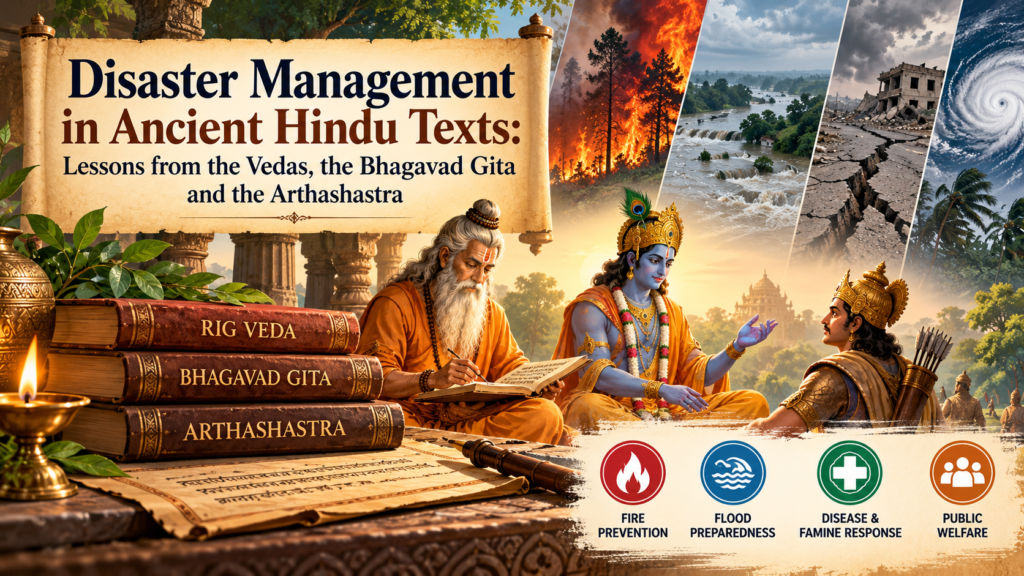
From fire prevention and flood preparedness to environmental responsibility and public welfare, ancient Indian texts offer valuable lessons for modern disaster risk reduction.
Introduction: Disaster Management Is Not a New Idea
When we discuss Disaster Management today, we often refer to modern frameworks such as the Disaster Management Act, 2005, the National Disaster Management Authority (NDMA), early warning systems, evacuation plans, fire safety audits and emergency response teams.
However, the fundamental questions behind Disaster Management are much older:
- How should communities prepare for natural hazards?
- What responsibility does a ruler have to protect people?
- How should society respond to fire, floods, disease and famine?
- Why should the welfare of the community take priority over individual interests?
- How can human beings live responsibly with nature?
Ancient Indian literature explored several of these questions long before the development of modern disaster-management institutions.
The Vedas, the Bhagavad Gita and other Hindu philosophical texts contain ideas about the relationship between human beings and nature, collective responsibility, duty and the protection of life. Kautilya’s Arthashastra, a classical Indian work on governance and statecraft, goes further by discussing specific hazards and measures for protecting a kingdom.
These texts should not be confused with modern technical manuals. Nevertheless, when interpreted carefully, they offer an important historical perspective on preparedness, prevention, governance and community resilience.
- Kautilya’s Arthashastra: A Remarkably Practical Approach to Disasters
One of the clearest historical references to disaster management in ancient India appears in Kautilya’s Arthashastra.
In Book IV, Chapter 3, commonly translated as “Remedies against National Calamities,” the text identifies several threats, including fire, floods, disease and famine. It places responsibility on the ruler to protect the population from these dangers. https://www.wisdomlib.org/hinduism/book/kautilya-arthashastra/d/doc366107.html
This is significant because it moves beyond a purely spiritual interpretation of calamities and addresses the practical responsibilities of governance.
Fire prevention
The Arthashastra discusses precautions against fire, including arrangements for cooking during summer. Such measures reflect an understanding that everyday human activities can create serious hazards when conditions are unfavourable.
The modern parallel is clear. Fire safety depends not only on firefighting equipment but also on preventing ignition, managing combustible materials, maintaining electrical systems and establishing safe operating procedures.
Today, a college, hospital, hotel or residential building needs functional fire protection systems, unobstructed exits, trained personnel and a workable evacuation plan. The underlying principle is similar: reduce the probability of an incident before relying on emergency response.
Flood preparedness
The text advises communities living in flood-prone areas to move away from flood-threatened locations during the rainy season. It also refers to keeping boats and other materials available to assist people being carried away by floodwaters. https://www.swaveda.com/texts/arthashastra/80/
These observations have direct parallels with modern flood risk management:
- Avoiding or limiting settlement in high-risk areas.
- Recognising seasonal hazards.
- Preparing rescue equipment before flooding occurs.
- Planning evacuation and rescue arrangements in advance.
- Helping people who are in immediate danger.
Modern flood management additionally requires hydrological data, flood forecasting, land-use planning, engineered protection and coordinated emergency services. Ancient practices were not substitutes for these technologies, but they demonstrate the enduring importance of preparedness.
Disease and famine
The Arthashastra also identifies disease and famine as major threats to the kingdom.
These hazards can undermine livelihoods, disrupt public services and weaken the ability of communities to recover. Their inclusion demonstrates that the security of a population cannot be reduced to defence against military threats alone.
Modern Disaster Management similarly addresses public health emergencies, food security, essential supplies and continuity of critical services.
Lesson for today: Good governance must anticipate hazards, prepare resources and protect people before a crisis becomes uncontrollable.
- The Atharva Veda: Respect for the Earth and the Natural Environment
The Atharva Veda’s Prithvi Sukta, or Hymn to the Earth, in Book XII, Hymn 1, presents the Earth as the foundation of life. It describes the Earth in relation to mountains, forests, waters, plants, animals and human communities. https://en.wikisource.org/wiki/Atharva-Veda_Samhita/Book_XII/Hymn_1
The hymn is a work of reverence and reflection, not a modern environmental risk assessment. Yet its emphasis on the relationship between people and the natural world provides a meaningful starting point for thinking about environmental responsibility.
The relationship between environmental degradation and disasters
Modern disaster research shows that the consequences of a hazard depend partly on human decisions.
For example:
- Construction in floodplains can increase exposure to flooding.
- Destruction of vegetation may contribute to soil erosion and slope instability in susceptible areas.
- Unplanned urbanisation can obstruct natural drainage and worsen waterlogging.
- Degradation of ecosystems can reduce some of the natural protection they provide against hazards.
These outcomes depend on local conditions; not every environmental change produces a disaster. Nevertheless, the broader principle is important: the way people use land and natural resources can increase or reduce risk.
The Earth-centred perspective of the Prithvi Sukta can therefore inspire a modern ethic of environmental stewardship.
Lesson for today: Development should respect ecological limits and consider the long-term safety of communities, not merely immediate economic benefits.
- The Bhagavad Gita: Duty, Leadership and Collective Welfare
The Bhagavad Gita is primarily a philosophical and spiritual text. It is not a disaster-management manual, but some of its teachings offer a useful ethical framework for emergency preparedness and public service.
One particularly relevant concept is lokasangraha, commonly understood as the welfare, cohesion or maintenance of the world.
In Bhagavad Gita 3.20, Krishna refers to leaders such as King Janaka and emphasises performing one’s duties with the welfare of the world in view. Verse 3.25 develops the idea that the wise should act with the welfare of the world as their objective. https://www.bhagavadgita.fyi/chapter/3/verse/20/
What does this mean for Disaster Management?
Disaster preparedness requires people to perform responsibilities even when an emergency appears unlikely.
A principal must ensure that emergency procedures are understood. A building manager must maintain safety systems. Public authorities must prepare for foreseeable hazards. Community volunteers must know how to assist without putting themselves or others at unnecessary risk.
These activities may not attract attention when nothing goes wrong. Yet their value becomes evident during a crisis.
The Gita’s emphasis on duty and collective welfare can be applied to the conduct of public officials, institutional leaders and community members.
A leader’s responsibility is not simply to issue instructions after an incident. It includes setting an example, ensuring that preparations are made and encouraging people to take safety seriously.
Lesson for today: Disaster preparedness is a public duty, not merely an administrative formality.
- Collective Responsibility: No Community Can Depend on One Person Alone
Disasters often overwhelm individual capacity. Rescue, evacuation, medical assistance, shelter and restoration require cooperation between authorities, institutions and communities.
Ancient Indian traditions contain many examples of collective action and mutual responsibility. However, it is important not to attribute every modern emergency-management concept directly to a particular verse unless the source supports that interpretation.
The practical principle remains relevant: community resilience improves when people understand their responsibilities and coordinate their actions.
In a modern school, for example, preparedness may involve:
- A designated School Disaster Management Team.
- Teachers trained in evacuation procedures.
- Security guards who understand alarm and access-control arrangements.
- Students who know their evacuation routes.
- Maintenance staff who can report hazards.
- A clear system for contacting emergency services.
- Arrangements to account for all occupants at assembly points.
In a village exposed to floods, similar cooperation may involve local warning systems, evacuation support, rescue resources and assistance for older people and persons with disabilities.
Preparedness must be organised before an emergency occurs. Goodwill alone cannot replace clear responsibilities and practice.
- Ancient Wisdom and Modern Fire Safety
Fire provides a particularly useful example of the connection between historical observations and modern safety practice.
The Arthashastra discusses fire precautions as part of protecting settlements and the state. Today, fire safety requires a much more detailed technical approach, including risk assessment, building design, electrical safety, fire detection, suppression systems and evacuation planning.
A fire extinguisher or a Fire NOC alone does not guarantee that occupants can escape safely.
Buildings also need clear and usable escape routes, appropriate emergency signage, functioning systems, trained personnel and procedures that reflect the actual building layout.
Modern institutions should therefore combine prevention with preparedness:
- Identify potential sources of ignition and combustible materials.
- Inspect and maintain relevant fire-safety systems.
- Keep exits and escape routes unobstructed.
- Display accurate evacuation information.
- Train designated emergency response teams.
- Conduct suitable drills and correct the deficiencies identified.
- Review the plan when building layouts or occupancy change.
The ancient text provides a historical reminder of the importance of precautions. Contemporary fire engineering and applicable safety regulations determine the technical measures required today.
- From Famine and Disease to Comprehensive Disaster Risk Reduction
The inclusion of disease and famine in the Arthashastra is also relevant to how we define disasters.
Disaster risk is not limited to spectacular events such as earthquakes, cyclones or floods. A public health emergency, a prolonged disruption of essential supplies or a major failure of critical infrastructure can also threaten lives and livelihoods.
A comprehensive approach considers four connected areas:
Prevention: Avoid creating new risks wherever possible.
Mitigation: Reduce the potential consequences of hazards.
Preparedness: Establish plans, resources, training and warning arrangements before an emergency.
Response and recovery: Protect lives during an incident and restore essential services and livelihoods afterwards.
These are modern disaster-management concepts, not terminology that should be retrospectively attributed to the ancient texts. However, the historical concern with fire, floods, disease and famine shows that protecting a population requires attention to multiple forms of risk.
- What Can India Learn from These Texts Today?
Ancient Indian texts should neither be dismissed as irrelevant nor presented as substitutes for modern science.
Their contribution is best understood through careful interpretation.
The Arthashastra provides historical examples of state responsibility and practical precautions against several hazards. The Prithvi Sukta expresses reverence for the Earth and the natural world. The Bhagavad Gita offers an ethical perspective on duty, leadership and collective welfare.
Modern Disaster Management adds scientific hazard assessment, engineering, forecasting, emergency communications, statutory responsibilities and tested operational procedures.
Together, these perspectives can encourage a culture in which public welfare, responsible governance and preparedness are treated as continuing priorities.
For India today, this means:
- Schools and colleges should maintain practical, site-specific Disaster Management Plans.
- Hospitals should prepare for fires, power failures, medical emergencies and disruption of critical services.
- Urban authorities should address drainage, land-use planning and risks associated with unsafe buildings.
- Communities should understand local hazards and participate in preparedness activities.
- Institutions should train their emergency teams and test their procedures rather than relying exclusively on written plans.
- Environmental considerations should be incorporated into development and risk-reduction decisions.
The purpose of drawing lessons from the past is not to claim that ancient texts contained all the answers. It is to recognise that questions of public safety, responsible leadership and protection of communities have deep historical roots.
Conclusion: Ancient Wisdom Must Lead to Modern Preparedness
Disaster Management is ultimately about protecting life, reducing suffering and strengthening the ability of communities to withstand emergencies.
Ancient Indian literature offers valuable perspectives on these responsibilities. Kautilya’s Arthashastra discusses practical measures against fire, floods, disease and famine. The Atharva Veda’s Prithvi Sukta expresses reverence for the Earth. The Bhagavad Gita emphasises duty and action directed towards collective welfare.
These are different texts with different purposes, and their teachings should be interpreted in their historical and philosophical contexts.
But they raise questions that remain relevant: Are we protecting our communities? Are our leaders fulfilling their responsibilities? Are we respecting the environment? Are we preparing before disaster strikes?
The real tribute to ancient wisdom is not merely to quote it. It is to translate the values of responsibility, foresight and public welfare into practical action.
For modern India, that means combining ethical leadership and community participation with scientific risk assessment, safe infrastructure, professional Disaster Management Plans, training and regular emergency exercises.
Preparedness is not a prediction that disaster will occur. It is a commitment to reducing the harm when hazards arise.
No Comments