 Collate Ideas For Community Radio Policy

Introduction
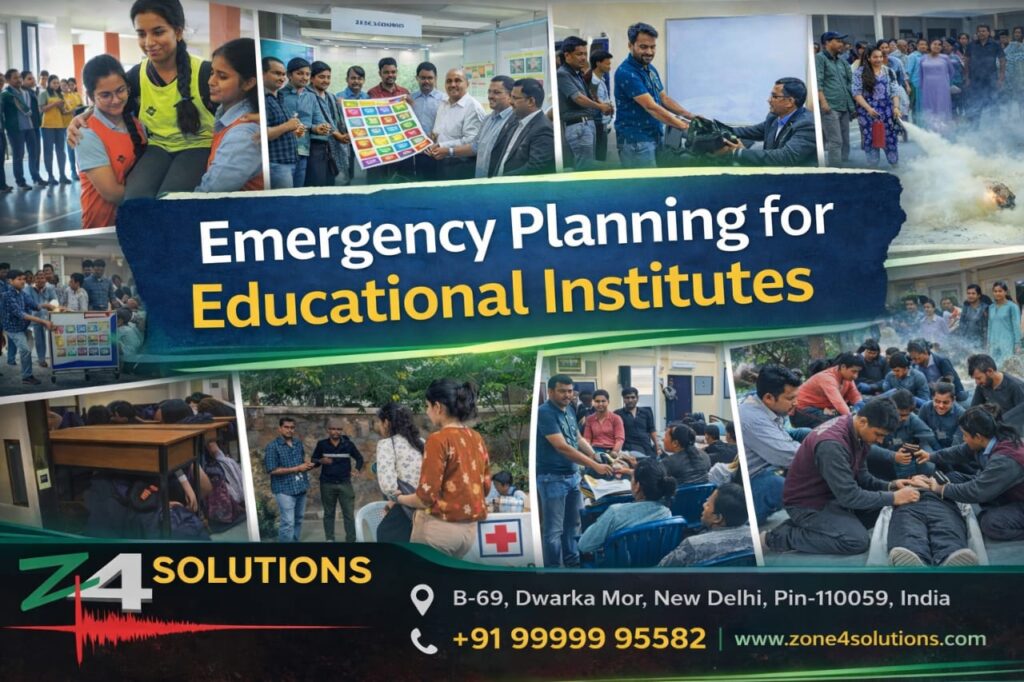
Educational institutions are among the most sensitive and high-risk public infrastructures. Every day, thousands of students, teachers, and staff members occupy school and college campuses with an implicit expectation of safety. However, research and past incidents clearly show that most educational institutions remain underprepared for emergencies such as earthquakes, fires, floods, medical emergencies, and security threats. Emergency planning is not a formality. It is a structured and continuous risk management process that protects lives, ensures operational continuity, and reduces legal and reputational risks. This document presents a complete, consulting-oriented emergency planning framework for schools and colleges.
In the 2013 floods, about 600 villages were damaged in Uttarakhand where schools were either damaged (fully or partially) or were used as emergency shelters. In the same year, cyclone Phailin caused damage to approx. 5825 schools in Odisha. In 2014, Andhra Pradesh was hit by Cyclone Hudhud, causing damage to 4 districts, 41,269 houses, and 455 buildings, including 317 schools. During and after the flood in Chennai City in December 2015, several schools were closed for more than a month to ensure the safety of the communities as did several schools in Srinagar, Kashmir, in 2014. Schools in Assam, Bihar, Madhya Pradesh, Uttar Pradesh, and Uttarakhand were closed due to flooding in 2016. Over 18 lakh people in 22 districts were affected by the flooding in Assam in 2016.
Education is universal human right. This right should not be ignored, sacrificed, interrupted or suspended as it results in everlasting socio-economic costs for students, their families, and communities. Since schools are the institutions for sharing knowledge and providing skills, it is expected from them to be universal role models for disaster preparedness and thus, it is important to mainstream disaster management in educational planning including the safety of school buildings. We cannot completely avoid disasters but through community-oriented preparedness and preventive actions, we can reduce the impacts of associated risks to some extent.
In general school safety is defined as schools and school-related activities where students are safe from violence, bullying, harassment, and substance use. Safe schools promote the protection of students from violence, exposure to weapons and threats, theft, bullying, and the sale or use of illegal substances on school grounds. But, school safety in disaster Management defined as reduction of overall risk of student in school from natural and manmade disaster.
Home to home school safety means Disaster Risk Reduction from home from where students start to schools – in school and while returning from school to home. Idea is to make students able to understand the risk on the way and in school and learn the basics how to react in case of any emergency strike on the way to school and in the school.
When a child is exposed to a disaster, the emotional responses can range from minimal distress to inattention, fear, lack of enjoyment (anhedonia), anxiety, and depressed mood, to symptoms of re-experiencing, avoidance, hypervigilance, and disruptive behavior. In many instances these symptomatic reactions are considered normal responses to a traumatic experience and are time limited. Children, however, may also have significant impairment and chronic symptomatology.
As emphasized in the GAP Humanitarian Intervention Guide, children in humanitarian emergencies are often exposed to major losses and/or potentially traumatic events. Such events trigger a wide range of emotional, cognitive, behavioral, and somatic reactions. People with severe reactions are particularly likely to present to clinical services for help. Clinicians need to be able to distinguish between reactions that do not require clinical management, and those who need clinical management.
Transient reactions for which people do not seek help and that do not impair day-to-day functioning (beyond what is culturally expected in case of bereavement) do not need clinical management. In these cases, health providers need to be supportive, help address the person’s need and concerns, and monitor whether expected natural recovery occurs.
People with acute stress or grief may present with a wide range of non-specific psychological and medically unexplained physical complaints. Recognize that help seeking may be a poor indicator of need—various factors including shame, fear of consequences, actual physical barriers may lead people in need to not seek services or resist being identified as in need of help.
There is a range of emotional responses or reactions that can be seen, some of which are more likely to occur during or immediately after the disaster and some which are more likely to be seen later. The emotional response to disaster is often conceptualized as a linear model with different phases.
The first stage, occurring immediately after the traumatic experience, often include reactions of fear, denial, confusion, and sorrow as well as feelings of relief if loved ones are unharmed. It may also include dissociative symptoms: feelings of emotional numbing, being in a daze, a sense of what has occurred is not real or that one does not feel like oneself, or lack of memory for some aspects of the experience (amnesia).
The second stage occurs days or weeks after the disaster. In many children it may be characterized by regressive behavior (in younger children) and signs of emotional stress such as anguish, fear, sadness, and depressive symptoms; hostility and aggressiveness against others; apathy, withdrawal, sleep disturbance, somatization, pessimistic thoughts about the future, and repetitive play enactment of the trauma.
As long as these symptoms do not impair normal childhood activities, they are considered part of the normal recovery process and they can be expected to lessen or disappear after some weeks. Emotional responses that are persistent and impair a return to normal functioning should be considered pathologic.
The emotional impact of disaster on children of school age is also strongly related to the adaptation of their caregivers. They comprehend the notion of good and bad, and as they develop, they can verbally express their feelings and emotions. However, disasters typically surpass the ability of many people to cope and it is common for children to feel confused and worried about their own reactions.
An appropriate response for school age children is to provide them a safe space where they can share their experience and fears. A dialogue with caregivers can be very helpful, especially if the caregiver is adapting well.
School-age children frequently worry about their behavior during the disaster. They may feel responsible for not having done enough and may blame themselves. It is important to create conditions where they can express their feelings and emotions, and to reassure them that what happened was nobody’s fault (particularly in natural disasters), and especially not their fault.
Children of all ages (and even adults) may worry that something they did or failed to do, or even just thought or wished about, may have caused, or contributed to the disaster or the death of loved ones, even if there is no logical reason for such feelings. Children are naturally reluctant to disclose such feelings of guilt, which may significantly impair their adjustment to the disaster.
When traumatic reminders trigger specific fears, it is important to help them identify and verbalize the setting and/or emotion that elicited those feelings. Although they may be able to understand what occurred, repeated graphic images of the disaster can trigger and exacerbate feelings of fear and anxiety. One way to minimize the impact of media exposure is to watch TV together and mutually share their emotions about the images and the event.
Some children will repeatedly reenact a traumatic situation with obsessive detail, cognitive distortions, and occasionally with an absence of specific information. Frequently the intensity of the emotions is so extreme that children may become overwhelmed. It is important to allow them to cry and express anger and sadness. If this occurs in the presence of supportive parents or caregivers, it can be quite therapeutic.
If they are unable to verbally express themselves, art and play material can assist them. Encourage continued socialization of children, but without making it burdensome. Plan structured activities for the differing developmental stages and interests. These activities are beneficial for children and for the community. For example, children can help with cleaning the school.
https://www.aap.org/en-us/Documents/disasters_dpac_PEDsModule9.pdf
Disaster readiness is not only about responding to emergencies but about anticipation, preparedness, prevention, and resilience. This article presents a comprehensive framework, covering everything from basic awareness to advanced systems and integration.
1. Risk Identification and Hazard Mapping
Emergency planning begins with identifying potential hazards. Schools often rely on generic plans without assessing real on-site risks. A professional approach includes site inspections, hazard zoning, and probability-impact analysis. Location-based risks such as seismic zones, Dry Zone, flood-prone areas, fire hazards, and nearby industrial threats must be mapped clearly.
2. Vulnerability Assessment
Emergency plans must consider vulnerable groups including young children, students with disabilities, elderly staff, and visitors. Evacuation and response strategies should be inclusive and realistic. Ignoring vulnerability leads to evacuation failure and injuries.
3. Disaster Management Committee
A structured Emergency Management Committee (DMC) ensures School Disaster Management Plan. This committee includes internal as well external members. From institution principal/ director and few staff and from external side one representatives from Civil Defence, one from NGO and similaty one can be from Fire department can be taken.
4. Disaster Management Plan signed by a qualified Disaster management expert
A professional emergency response plan includes emergency types, roles, evacuation procedures, assembly points, medical response, communication systems, and coordination with external agencies. Written plans improve response effectiveness and accountability.
5. Self-Glowing Evacuation Maps
Self-Glowing Evacuation Maps is the backbone of emergency response. Clear exit routes, assembly areas, signage, and floor-wise evacuation maps reduce panic and confusion. These maps must be displayed prominently and tested during drills. These maps glow in Drafk smoke to show the way. It helps both parties. first party is the evacuee and second party is the response team. Both can see the maps in dark smoke understand the lay outs of the building.
6. Emergency Communication Systems
Clear communication prevents panic. Alarm systems, only hooters will not solve the problem, because some of evacuee maigh be hearing impaired. Hence must have an inclusive emergency alarm. Similarly don’t bank 100% on public address systems, emergency contact lists, and parent communication protocols must be established and tested regularly.
7. First Aid and Medical Preparedness
Medical readiness saves lives before external help arrives. Institutions must maintain first-aid kits, trained responders, hospital tie-ups, and health records for students and staff.
8. Training and Capacity Building
Emergency plans are ineffective without training. Teachers, staff, students, and support personnel must receive regular, role-based training covering evacuation, fire response, and basic life support.
9. Mock Drills and Simulations
Mock drills convert plans into action. Institutions should conduct multiple drills annually, evaluate response time, document gaps, and implement improvements. Regular drills significantly enhance preparedness.
10. External Agency Coordination
Coordination with fire services, police, hospitals, and disaster management authorities strengthens emergency response. Integrated planning ensures faster and more organized action.
11. Review and Continuous Improvement
Emergency planning is not static. Post-drill reviews, plan updates, retraining, and infrastructure improvements are essential for sustainable safety.
Conclusion
Disasters don’t ask for files.
They test behaviour.
And behaviour cannot be printed, approved, or uploaded.
It must be trained. Repeated. Rehearsed—until it becomes instinct.
A real disaster plan is not a document.
It is a system.
A system that answers hard questions:
Who takes the first decision—without waiting?
Who guides children, patients, guests, and staff?
What happens if the key person is absent?
Do people know what to do in the first 30 seconds?
Compliance may give institutions confidence.
But only preparation gives them control.
So if your institution has a disaster plan, ask one honest question:
If something went wrong tomorrow—would your people act, or would they first look for the file?
Emergency planning in educational institutions is not optional.
It is a moral, legal, and operational necessity.
No Comments