 Collate Ideas For Community Radio Policy

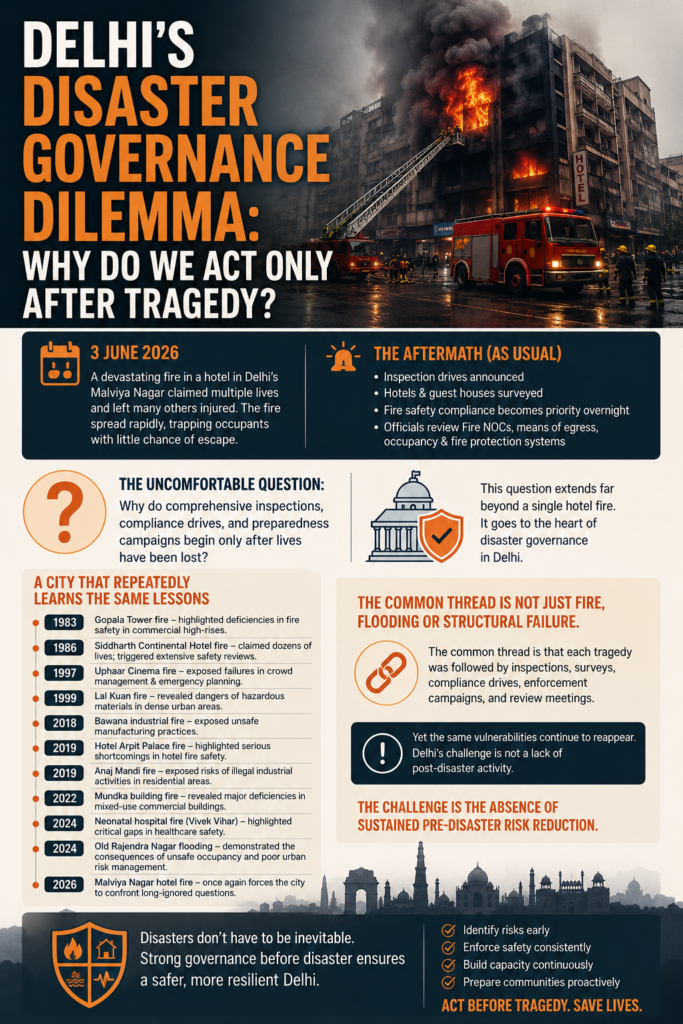
Delhi’s Disaster Governance Dilemma: Why Do We Act Only After Tragedy?
On 3 June 2026, a devastating fire in a hotel in Delhi’s Malviya Nagar claimed multiple lives and left many others injured. Reports indicated that the fire originated on the lower floors and rapidly spread through the building, trapping occupants who had little chance of escape. Some reportedly jumped from upper floors in desperate attempts to survive.
As expected, the tragedy triggered an immediate response. Inspection drives were announced. Hotels and guest houses were surveyed. Fire safety compliance became a priority overnight. Officials reviewed Fire NOCs, means of egress, occupancy levels, and the operational status of fire protection systems.
While these actions are necessary, they also raise an uncomfortable question:
Why do comprehensive inspections, compliance drives, and preparedness campaigns begin only after lives have been lost?
This question extends far beyond a single hotel fire. It goes to the heart of disaster governance in Delhi.
A City That Repeatedly Learns the Same Lessons
Delhi’s disaster history is filled with incidents that shocked the public, exposed systemic vulnerabilities, and prompted government action.
The Gopala Tower fire in 1983 highlighted deficiencies in fire safety provisions in commercial high-rise buildings.
The Siddharth Continental Hotel fire in 1986 claimed dozens of lives and triggered extensive reviews of hotel safety.
The Uphaar Cinema fire in 1997 exposed failures in crowd management, emergency planning, and means of egress.
The Lal Kuan fire in 1999 revealed the dangers of hazardous materials being stored within densely populated urban areas.
The Bawana industrial fire in 2018 exposed unsafe manufacturing practices.
The Hotel Arpit Palace fire in 2019 highlighted serious shortcomings in hotel fire safety compliance.
The Anaj Mandi fire later that year exposed the risks associated with illegal industrial activities operating in residential areas.
The Mundka building fire in 2022 revealed major deficiencies in mixed-use commercial buildings.
The neonatal hospital fire in Vivek Vihar in 2024 highlighted critical gaps in healthcare safety management.
The flooding tragedy in Old Rajendra Nagar in 2024 demonstrated the consequences of unsafe occupancy practices and poor urban risk management.
And now, the Malviya Nagar hotel fire has once again forced the city to confront questions that should have been addressed long before the disaster occurred.
The common thread linking all these incidents is not merely fire, flooding, or structural failure.
The common thread is that each tragedy was followed by inspections, surveys, compliance drives, enforcement campaigns, and review meetings.
Yet the same vulnerabilities continue to reappear.
This suggests that Delhi’s challenge is not a lack of post-disaster activity.
The challenge is the absence of sustained pre-disaster risk reduction.
Disaster Management Is Not Disaster Response
One of the most persistent misconceptions in India is that disaster management begins when a disaster occurs.
When people hear the term “disaster management,” they often think about rescue teams, ambulances, relief camps, compensation announcements, and emergency response operations.
These are important functions.
However, they represent only one part of the disaster management cycle.
The Disaster Management Act, 2005 was enacted with a fundamentally different vision.
The Act emphasizes prevention, mitigation, preparedness, capacity building, and risk reduction alongside response and recovery.
The role of a Disaster Management Authority is not simply to coordinate relief after a tragedy.
Its primary responsibility is to identify risks before they become disasters.
This distinction is critical.
A city that responds effectively after every disaster may still be failing if the same disasters continue to occur.
Success cannot be measured solely by the efficiency of emergency response.
It must also be measured by the effectiveness of risk reduction.
The Fire Safety Analogy
The recent hotel fire offers an important lesson.
When fire safety is discussed, attention often focuses on visible equipment such as fire extinguishers, alarms, sprinklers, hydrants, and hose reels.
These systems are essential.
However, they are only one part of life safety.
The overall fire safety performance of a building depends equally on:
- Safe building design.
- Adequate means of egress.
- Protected escape routes.
- Self-glowing evacuation maps.
- Smoke management systems.
- Fire-resistant construction.
- Occupancy control.
- Emergency planning.
- Staff training.
- Regular evacuation drills.
A building may possess functioning fire extinguishers and still be unsafe.
Similarly, a city may possess emergency response capabilities and still be vulnerable to disasters.
Just as fire safety requires more than equipment, disaster management requires more than emergency response.
It requires a systematic approach to risk identification and vulnerability reduction.
The Real Challenge: Invisible Risks
Most disasters do not occur suddenly.
They develop gradually.
Risks accumulate over time.
Unauthorized construction takes place.
Escape routes become blocked.
Occupancies change.
Basements are converted into commercial spaces.
Electrical systems deteriorate.
Industrial activities emerge in unsuitable locations.
Drainage systems become inadequate.
Institutions stop conducting drills.
Emergency plans remain untested.
Compliance becomes a paperwork exercise rather than a safety process.
These vulnerabilities often remain invisible until a triggering event occurs.
The fire, flood, structural collapse, or industrial accident simply exposes problems that have existed for years.
This is why post-disaster inspections frequently uncover violations that should have been identified much earlier.
The disaster itself does not create the vulnerability.
It reveals it.
Is Delhi Truly Practicing Disaster Risk Reduction?
The concept of Disaster Risk Reduction (DRR) has become central to modern disaster management worldwide.
The Sendai Framework for Disaster Risk Reduction emphasizes understanding risk, strengthening governance, investing in resilience, and enhancing preparedness.
Under this approach, disasters are not viewed as isolated events.
They are viewed as the interaction between hazards and vulnerabilities.
Hazards cannot always be prevented.
Earthquakes will occur.
Heat waves will intensify.
Heavy rainfall will continue.
Fires will remain possible.
What can be controlled is vulnerability.
The question, therefore, is whether disaster governance systems are systematically reducing vulnerability across the city.
Are schools conducting regular evacuation drills?
Are hospitals testing their emergency plans?
Are high-rise buildings maintaining safe evacuation routes?
Are commercial establishments implementing their Disaster Management Plans?
Are hazard and vulnerability assessments being updated?
Are lessons learned from previous disasters being institutionalized?
Or are these activities receiving attention only after major incidents?
These are uncomfortable questions, but they are essential.
The Role of the Delhi Disaster Management Authority
The Delhi Disaster Management Authority (DDMA) occupies a unique position.
Unlike many departments that focus on a single hazard or sector, DDMA is expected to coordinate risk reduction across multiple domains.
Its mandate extends to:
- Earthquake preparedness.
- Fire safety coordination.
- Flood management.
- Heat wave preparedness.
- Industrial safety.
- Institutional preparedness.
- Community awareness.
- Capacity building.
- Disaster planning.
This places DDMA in a position to drive a city-wide culture of preparedness.
However, preparedness cannot be built through advisories alone.
It requires measurable implementation.
Plans must be operationalized.
Drills must be conducted.
Institutions must be audited.
Training programmes must be continuous.
Preparedness indicators must be monitored.
Risk assessments must be updated regularly.
Without these activities, disaster management risks becoming reactive rather than preventive.
What Would a Proactive Model Look Like?
Imagine a different approach.
Instead of launching inspections after a disaster, critical facilities could undergo annual preparedness audits.
Instead of checking documents alone, authorities could evaluate operational readiness.
Schools could be required to conduct multiple evacuation drills every year.
Hospitals could test emergency response procedures through realistic exercises.
Hotels and malls could demonstrate evacuation capabilities rather than merely producing compliance certificates.
High-risk buildings could be mapped and monitored continuously.
Digital platforms could track institutional preparedness across sectors.
Public dashboards could report preparedness indicators just as cities report pollution levels or weather conditions.
Such a system would not eliminate disasters.
No city can eliminate all risk.
However, it would significantly reduce vulnerability and improve resilience.
Most importantly, it would shift the focus from reaction to prevention.
Measuring Success Differently
Governments often receive recognition for responding effectively to disasters.
And rightly so.
Emergency responders save lives under extraordinarily difficult conditions.
But the ultimate objective of disaster management is not to create better disaster response systems.
It is to create safer communities.
The true measure of success should therefore be different.
Success should be measured by:
- Fewer preventable deaths.
- Reduced vulnerability.
- Increased preparedness.
- Greater institutional resilience.
- Better compliance with safety standards.
- Stronger community awareness.
In other words, success should be measured by the disasters that never happen.
Conclusion
The Malviya Nagar hotel fire should not be viewed merely as another tragic fire incident.
It should be viewed as an opportunity to rethink disaster governance in Delhi.
For more than four decades, the city has followed a familiar cycle:
Tragedy. Investigation. Inspection. Enforcement. Public attention. Gradual decline in focus. Another tragedy.
Breaking this cycle requires more than stricter enforcement after disasters.
It requires a sustained commitment to disaster risk reduction.
Delhi does not need another temporary compliance drive.
It needs a culture of preparedness.
It needs continuous risk assessment.
It needs institutional accountability.
It needs measurable resilience.
Most importantly, it needs to judge the effectiveness of disaster governance not by how well it responds after lives are lost, but by how successfully it prevents those losses from occurring in the first place.
That is the real promise of the Disaster Management Act, 2005.
And that is the challenge that Delhi must now confront.
No Comments