 Collate Ideas For Community Radio Policy

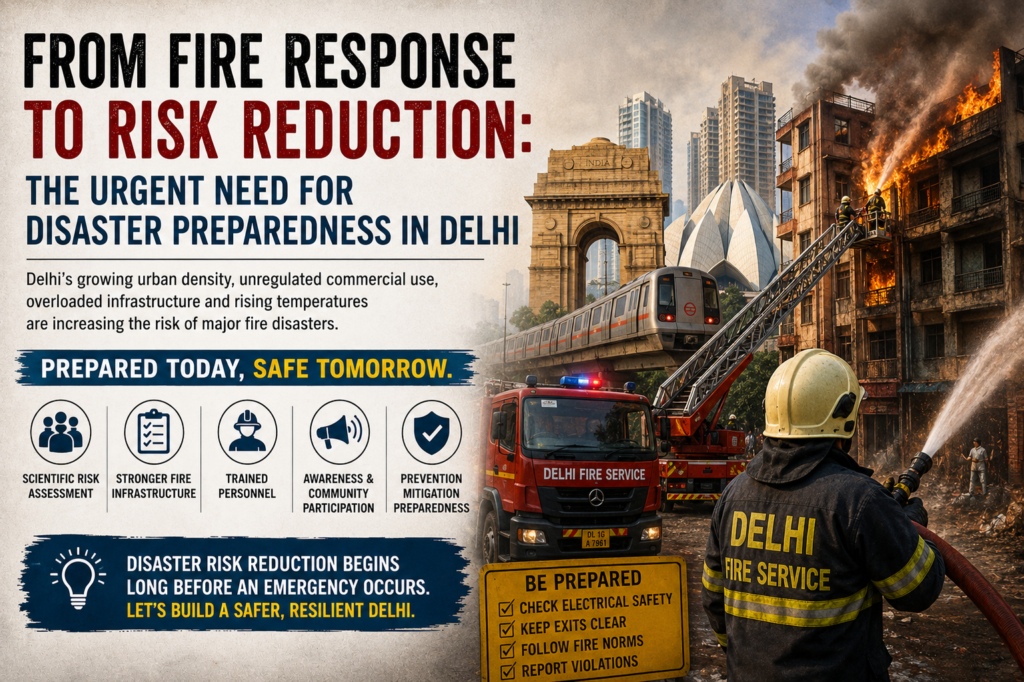
From Fire Response to Risk Reduction: The Urgent Need for Disaster Preparedness in Delhi
Urban fire risk in Delhi is no longer only a fire department issue. It has become a governance, planning, disaster management, and public safety challenge. The increasing conversion of residential properties into commercial establishments, combined with rising temperatures, overloaded infrastructure, and uncontrolled urban density, has significantly increased the probability of large-scale urban fire disasters.
Delhi today stands at a critical point where disaster risk is growing faster than disaster preparedness.
More than ten lakh properties in Delhi are reportedly being used for commercial purposes despite being approved originally for residential land use. A building designed to accommodate one family is now often functioning as a coaching center, guest house, warehouse, office, restaurant, clinic, factory unit, or mixed commercial establishment. This transformation has fundamentally altered the hazard profile of the city.
A residential building and a commercial building do not carry the same level of risk. When usage changes, the entire safety equation changes.
The number of occupants increases. Electrical load increases. Air-conditioning demand rises. Parking congestion increases. Fire load increases. Evacuation becomes difficult. Access for emergency vehicles becomes restricted. Informal modifications block exits and staircases. Diesel generators, inverters, battery systems, and temporary electrical wiring further increase the possibility of fire incidents.
At the same time, Delhi is experiencing increasingly severe summer temperatures. Heatwaves place tremendous pressure on electrical infrastructure. Overloaded systems, aging cables, illegal wiring, and unregulated commercial operations create ideal conditions for electrical fires.
As a result, Delhi Fire Services (DFS) today receives an extremely high number of emergency calls daily. Reports indicate that DFS is receiving more than 130 fire calls every day during peak summer periods. This itself is an indicator that urban fire risk in Delhi is intensifying rapidly.
The Government of Delhi has taken an important step by deciding to augment the capacity of Delhi Fire Services. This is a welcome decision. However, a critical question remains unanswered:
How much augmentation is actually required?
Has the requirement been scientifically calculated?
Has anyone assessed the present and future hazard load of Delhi in a systematic manner?
How many additional fire stations are required?
How many trained firefighters are needed?
How many specialized rescue vehicles are required?
How many hydraulic platforms, breathing apparatus sets, water tenders, command vehicles, and rescue tools are necessary for a city that is continuously densifying?
How many emergency response personnel are required to maintain safe response times under current and projected urban conditions?
These questions cannot be answered merely through administrative assumptions. They require scientific hazard and risk assessment.
In this context, it is important to remember that a major study titled “Fire Hazard and Risk Assessment of India” was conducted in 2010 under the Directorate General of Civil Defence, Ministry of Home Affairs. The study included Delhi and several other major urban centers. The study was conducted under the leadership of Nakul Kumar Tarun and attempted to scientifically assess fire hazards, response capability gaps, and future preparedness requirements.
The significance of that study has only increased with time.
During the last fifteen years, Delhi has witnessed:
- Massive urban expansion
- Population growth
- Increased commercialization
- High-rise development
- Growth of mixed land use
- Increased electricity demand
- Higher traffic congestion
- Expansion of informal settlements
- Growth of tourism infrastructure
- Increase in underground utilities and digital infrastructure
Therefore, the fire risk profile of Delhi today is substantially different from what it was in 2010.
The National Disaster Management Authority (NDMA) had also recommended augmentation of fire services based on national risk realities and institutional wisdom. However, augmentation of emergency services cannot remain a one-time administrative exercise. It must become a dynamic risk-based planning process.
Delhi is not merely another metropolitan city. It is the national capital of India.
It hosts:
- Parliament
- Supreme Court
- Central ministries
- Foreign embassies
- Strategic infrastructure
- International tourists
- Dense markets
- Religious gatherings
- Heritage structures
- High-rise buildings
- Major hospitals
- Educational institutions
- Transportation hubs
The city is now also being promoted as a major tourism and international activity hub. This means that the expectations from emergency response systems are becoming even higher.
No citizen, tourist, employee, student, patient, litigant, or visitor should feel unsafe because of inadequate emergency preparedness.
This is where the role of disaster management authorities becomes extremely important.
The Chief Executive Officer (CEO) of the Delhi Disaster Management Authority (DDMA) has a much larger role to play beyond post-disaster coordination. Modern disaster management philosophy emphasizes prevention, mitigation, preparedness, and risk reduction rather than only response after a disaster occurs.
Disaster Risk Reduction (DRR) begins long before a fire engine reaches the incident site.
It begins with planning.
It begins with hazard identification.
It begins with preparedness.
It begins with regulation and enforcement.
Unfortunately, many public buildings in Delhi still operate without functional Disaster Management Plans (DMPs), evacuation plans, or emergency preparedness systems.
This raises an important policy question.
If a few colleges of the University of Delhi can prepare Disaster Management Plans and evacuation systems, why not all colleges?
If a few public schools can implement the NDMA School Safety Guidelines, why not every school?
If some hospitals and malls can display evacuation maps, why are thousands of other public buildings still operating without them?
Why should emergency preparedness depend on institutional willingness rather than mandatory enforcement?
Under the Disaster Management Act 2005 and associated institutional frameworks, the Delhi State Disaster Management Authority (SDMA) and DDMA possess significant powers regarding preparedness, mitigation, and safety compliance.
The authorities are empowered to:
- Direct preparation of Disaster Management Plans
- Conduct safety audits
- Issue preparedness guidelines
- Coordinate with departments
- Enforce risk reduction measures
- Promote emergency planning
- Improve institutional resilience
This authority must now be used aggressively and systematically.
Every public building in Delhi should have:
- A Disaster Management Plan by a qualified disaster manager
- Self-glowing Evacuation maps
- Self-glowing evacuation signage
- Emergency lighting systems
- Fire safety systems
- Public announcement systems
- Assembly point identification
- Periodic mock drills
- Accessibility-focused evacuation procedures
The importance of self-glowing evacuation maps deserves special attention.
During major fire incidents, smoke often causes visibility failure. Electricity may fail. Panic conditions may emerge. In such scenarios, photoluminescent evacuation systems become extremely important because they continue to guide occupants even during power outages and smoke conditions.
Globally, self-glowing evacuation systems are considered critical components of life safety infrastructure in high-risk buildings.
Delhi must adopt such systems on a large scale, especially in:
- Schools
- Colleges
- Courts
- Hospitals
- Markets
- Metro-linked infrastructure
- High-rise buildings
- Government offices
- Cinema halls
- Hotels
- Religious places
- Coaching centers
- Mixed-use buildings
Development of a Disaster Management Plan is not a paperwork exercise.
It is the first operational step in the Disaster Risk Reduction cycle.
A proper DMP helps institutions understand:
- Their vulnerabilities
- Their hazards
- Their evacuation limitations
- Their response gaps
- Their communication systems
- Their accountability structure
Most importantly, it transforms preparedness from theory into operational capability.
The absence of DMPs in public buildings creates invisible vulnerability.
Many institutions assume that because a disaster has not happened yet, preparedness is unnecessary. This mindset is dangerous.
Every major disaster teaches the same lesson: preparedness delayed becomes response overwhelmed.
Delhi cannot depend only on the bravery and capacity of the Delhi Fire Services. Even the world’s best fire service cannot compensate for uncontrolled urban risk creation.
Emergency response must be supported by:
- Urban planning
- Building compliance
- Electrical safety
- Crowd management
- Fire prevention
- Public awareness
- Institutional preparedness
- Inter-agency coordination
The current situation demands a city-wide risk reassessment exercise.
Delhi requires a fresh scientific Fire Hazard and Risk Assessment study considering present-day realities.
The study should examine:
- Ward-wise hazard density
- Commercial conversion patterns
- Fire station accessibility
- Response times
- Water availability
- High-rise risks
- Market congestion
- Population density
- Heatwave-related risk increase
- Hazardous material storage
- Electrical load concentration
Such a study can scientifically determine:
- Additional manpower requirements
- Equipment needs
- Fire station expansion
- Specialized rescue capability
- Urban search and rescue requirements
- Command and control infrastructure
- Future investment priorities
Without scientific assessment, augmentation risks becoming reactive rather than strategic.
Delhi also requires stronger integration between:
- DDMA
- DFS
- MCD
- DDA
- Police
- CPWD
- Power utilities
- Education institutions
- Health systems
- Market associations
Urban disaster resilience cannot be built in silos.
Community participation is equally important.
Market associations, Resident Welfare Associations (RWAs), schools, colleges, hotels, and commercial establishments must be made stakeholders in preparedness.
Preparedness culture cannot be outsourced only to government agencies.
Climate change further complicates the situation.
Increasing temperatures, longer heatwaves, and stressed electrical systems will likely increase urban fire incidents in coming years.
This means that Delhi must now move from traditional fire response thinking toward climate-resilient urban risk management.
Preparedness should become visible across the city.
Citizens should see:
- Evacuation signage
- Emergency maps
- Safety drills
- Public awareness systems
- Emergency assembly markings
- Fire safety communication
Visible preparedness itself improves public confidence.
Delhi has the institutional capability, technical expertise, and administrative framework to become a national model in urban disaster risk reduction.
However, this requires urgency.
The city cannot wait for a catastrophic urban fire event to trigger reforms.
The question is no longer whether Delhi needs stronger preparedness systems.
The question is whether the city is willing to recognize the scale of risk that already exists.
The development and enforcement of Disaster Management Plans across all public buildings is not merely an administrative formality.
It is a life safety necessity.
It is an urban governance necessity.
And for the national capital, it is a strategic necessity.
Vivek Vihar Fire Tragedy: A Critical Warning for Delhi’s Disaster Preparedness System
One of the most painful reminders of Delhi’s growing urban fire vulnerability was the tragic Vivek Vihar fire incident. The incident exposed serious gaps in urban risk management, fire prevention, emergency preparedness, building compliance, and enforcement systems.
The tragedy demonstrated how hazardous urban development, combined with weak preparedness mechanisms, can rapidly convert ordinary infrastructure into a death trap.
The incident was not merely a fire accident. It was a systemic failure involving multiple layers of urban governance and safety oversight.
Why the Vivek Vihar Fire Became a National Concern
The Vivek Vihar incident shocked the nation because it highlighted how vulnerable densely populated urban areas have become due to:
- Congested access routes
- Mixed land use patterns
- Inadequate emergency planning
- Poor fire safety compliance
- Delayed evacuation capability
- High occupancy load
- Unregulated infrastructure modifications
The incident also raised difficult questions regarding whether existing emergency systems are capable of handling rapidly intensifying urban risks in Delhi.
Lessons from the Incident
The Vivek Vihar fire should not be viewed as an isolated event. It should be treated as a warning signal for the entire city.
- Every Building Has a Changed Risk Profile
Many buildings in Delhi are no longer being used according to their original design intent.
Structures originally planned for residential use are increasingly functioning as:
- Commercial establishments
- Clinics
- Warehouses
- Guest houses
- Offices
- Educational centers
- Mixed-use facilities
This increases:
- Occupancy load
- Electrical demand
- Fire load
- Evacuation complexity
- Congestion pressure
The Vivek Vihar incident reinforced the reality that when land use changes but safety systems do not evolve accordingly, disaster risk multiplies.
- Evacuation Planning Saves Lives
One of the most critical observations from major fire incidents across India is that casualties often occur not because the fire starts, but because evacuation fails.
In many buildings:
- Occupants do not know escape routes.
- Exit signage is absent.
- Staircases are blocked.
- Emergency lighting fails.
- Panic overwhelms occupants.
The Vivek Vihar tragedy demonstrated why every public building must have:
- A Disaster Management Plan
- Floor-wise evacuation maps
- Self-glowing evacuation signage
- Functional emergency lighting
- Trained emergency coordinators
- Regular mock drills
- Narrow and Congested Urban Access Delays Emergency Response
One of the biggest challenges in Delhi’s urban landscape is access congestion.
Illegal parking, encroachments, mixed commercial activity, roadside occupation, and unplanned densification often reduce maneuverability for fire tenders.
Even the best-equipped fire service cannot perform effectively if response vehicles cannot reach the incident location quickly.
The Vivek Vihar incident again highlighted the importance of integrating urban planning with disaster management.
- Heatwaves and Electrical Overload Are Increasing Urban Fire Risk
Delhi’s rising summer temperatures are placing extraordinary pressure on electrical infrastructure.
In areas where buildings were originally designed for residential consumption but are now operating commercial loads, electrical systems often become severely stressed.
This includes:
- Air-conditioning overload
- Illegal wiring
- Temporary electrical connections
- Overloaded transformers
- Poor maintenance
The combination of heatwaves and unregulated electricity demand is creating an increasingly dangerous urban fire environment.
- Fire Safety Cannot Depend Only on Fire Services
The Vivek Vihar incident clearly showed that urban fire safety is not solely the responsibility of Delhi Fire Services.
Fire prevention begins much earlier through:
- Safe building design
- Compliance enforcement
- Hazard identification
- Preparedness planning
- Public awareness
- Electrical safety
- Evacuation systems
- Regular inspections
Delhi Fire Services can respond to emergencies, but preventing large-scale casualties requires citywide preparedness.
The Need for a Delhi-Wide Preparedness Movement
The lessons from Vivek Vihar must now push Delhi toward a proactive disaster risk reduction model.
The city requires:
- Mandatory Disaster Management Plans
- Scientific fire risk assessment
- Enforcement of evacuation systems
- Self-glowing emergency maps
- Building-wise hazard analysis
- Periodic mock drills
- Institutional accountability
- Integrated urban safety planning
Most importantly, preparedness must become visible and operational rather than remaining limited to paperwork.
A Turning Point for Urban Safety
Every major disaster leaves behind two choices.
The first is temporary outrage followed by institutional forgetfulness.
The second is systemic reform.
The Vivek Vihar tragedy should become a turning point in Delhi’s urban disaster management approach.
If the city genuinely aims to become a global capital and tourism hub, then safety, preparedness, and resilience must become central components of governance.
No citizen should lose life because a building lacked evacuation planning.
No emergency responder should struggle because roads are inaccessible.
And no institution should operate without understanding its disaster vulnerabilities.
The true tribute to victims of urban fire disasters lies not only in sympathy but in building systems that prevent repetition of such tragedies.
No Comments