 Collate Ideas For Community Radio Policy

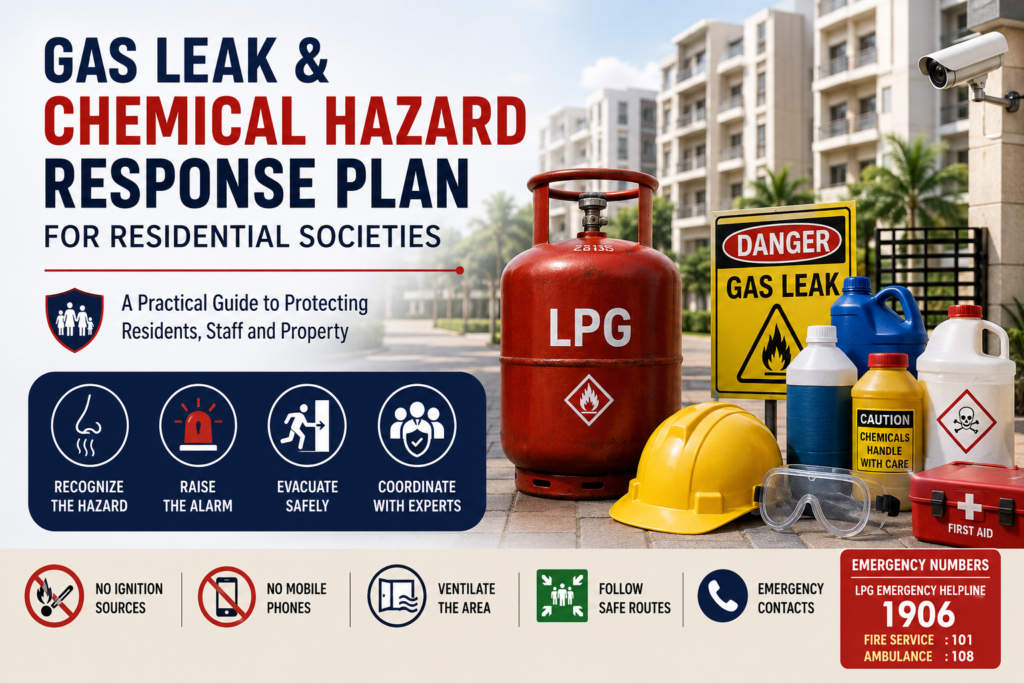
Introduction
A residential society is often treated as one of the safest places to live. It has security guards, CCTV cameras, fire extinguishers, electrical systems, parking areas and, in many cases, a dedicated maintenance team. Yet modern residential complexes contain several sources of gas and chemical hazards that can quickly turn an ordinary incident into a major emergency.
Domestic LPG cylinders, piped natural gas, diesel generators, batteries, cleaning chemicals, pesticides, paints, solvents, swimming-pool chemicals and maintenance materials may all be present within or around a residential complex. In addition, chemicals may be brought into individual apartments by housekeeping personnel, contractors, pest-control agencies or residents.
A gas leak or chemical release is particularly dangerous because the hazard may not always be visible. A leaking gas can accumulate before anyone realizes that something is wrong. A chemical spill may produce toxic vapours, create a fire hazard or cause burns. An inappropriate response, such as switching on an electrical appliance, using a mobile phone close to a suspected gas leak, attempting to clean an unknown chemical or moving towards a vapour cloud, can make the situation worse.
Therefore, residential societies need more than fire extinguishers and emergency contact numbers. They need a simple, practical and tested Gas Leak & Chemical Hazard Response Plan.
The objective of such a plan is not to turn residents into firefighters or hazardous-material specialists. It is to ensure that residents and society staff know how to recognize a hazard, what not to do, how to raise the alarm, when to evacuate or shelter, and how to coordinate with professional responders.
India’s official disaster-management guidance emphasizes community preparedness, identification of safe routes and shelters, emergency contacts, training and community disaster-management planning for chemical hazards.
- Understanding Gas and Chemical Hazards in Residential Societies
The first step in preparedness is understanding where hazards may originate.
Common gas-related hazards
Residential societies may encounter:
- LPG cylinders in individual homes
- LPG cylinders used by restaurants or food outlets
- PNG connections
- Gas pipelines
- LPG storage areas
- Gas-operated appliances
- DG-set fuel systems
- Vehicles and fuel storage
- Compressed gases used for maintenance activities
A gas leak can create two major risks: fire/explosion and exposure to the gas itself.
In many cases, the greatest danger is not the leak alone but the presence of an ignition source. A spark from a switch, electrical appliance, vehicle, flame or other ignition source can potentially ignite an accumulated flammable gas-air mixture.
This is why the first principle of gas-leak response should be: Do not create an ignition source while investigating the leak.
For domestic LPG emergencies in India, the Ministry of Petroleum and Natural Gas identifies 1906 as the 24×7 LPG Emergency Helpline.
- Chemical Hazards Are Not Limited to Factories
The word “chemical” often creates an impression that chemical emergencies occur only in industrial areas. That is not correct.
Residential complexes routinely contain chemicals.
For example:
Housekeeping chemicals
- Toilet cleaners
- Bleaching agents
- Disinfectants
- Floor cleaners
- Acids and alkaline cleaners
Maintenance chemicals
- Paints
- Thinners
- Adhesives
- Lubricants
- Solvents
Gardening and pest control
- Pesticides
- Insecticides
- Herbicides
- Fumigation chemicals
Swimming-pool chemicals
- Chlorine-based products
- Water-treatment chemicals
- pH-control chemicals
Electrical and battery systems
- Battery electrolytes
- Battery-related chemicals
- Damaged or overheating battery systems
The danger is increased when incompatible chemicals are stored together or when chemicals are transferred into unlabelled containers.
A fundamental rule should therefore be:
Never use an unidentified chemical and never mix chemicals unless the product instructions specifically permit it.
For chemicals requiring formal emergency planning, India’s chemical-emergency framework provides for emergency planning, preparedness and response, including coordination among authorities.
- Why Residential Societies Need a Dedicated Response Plan
A residential society is different from a factory.
A factory normally has trained safety personnel, controlled access and documented chemical inventories. A residential society may have hundreds or thousands of residents, children, elderly persons, domestic workers, visitors, security personnel and maintenance contractors.
During an emergency, the management may not immediately known:
- Where the leak originated
- Which building is affected
- What substance is involved
- How many people are exposed
- Whether evacuation is safe
- Which residents require assistance
- Whether the substance is flammable or toxic
- Which emergency agency should be contacted
This uncertainty can create panic. A well-designed response plan converts uncertainty into a predefined process.
- The First 10 Minutes Matter
A gas or chemical emergency should be managed through a simple sequence:
Recognize → Raise Alarm → Isolate → Evacuate/Shelter → Inform → Account → Hand Over
The exact response will depend on the substance, location, size of release and advice from emergency responders.
The first objective should always be life safety.
Residents should not be encouraged to investigate the source themselves.
If a gas leak is suspected:
- Stay calm.
- Avoid flames, smoking and other ignition sources.
- Do not operate electrical switches if doing so could create a spark.
- Move people away from the suspected area.
- Raise the alarm through the society’s emergency system.
- Contact the appropriate emergency service from a safe location.
- Follow instructions from the fire service, police, gas supplier or other competent authority.
- Do not re-enter until the area has been declared safe.
For a suspected chemical release, the response may instead require isolation or shelter-in-place, depending on the substance and advice from authorities. Official Indian fire-service guidance specifically notes that chemical incidents may require people to move away from the release and, where appropriate, remain indoors with doors and windows closed while awaiting instructions.
- Evacuation Is Not Always the Correct Response
One of the most important principles of chemical emergency management is that every incident should not automatically trigger evacuation.
Suppose a chemical vapour is moving outside a building. Opening doors and moving people through the contaminated area could expose more residents.
In such circumstances, authorities may advise people to remain indoors and close doors and windows.
Conversely, if there is a major LPG leak inside a building, remaining inside may be dangerous and evacuation may be necessary.
Therefore, the society’s plan should distinguish between:
Evacuation
People move away from the hazard to a designated safe assembly area.
Shelter-in-place
People remain inside a relatively safe building or room, close openings and await instructions.
The correct decision depends on the nature, location and movement of the hazard.
- Establish an Emergency Command Structure
A residential society should not depend on one person during an emergency.
The Resident Welfare Association (RWA) or society management should establish a small Emergency Response Team (ERT).
A suggested structure could include:
Incident Coordinator
Responsible for overall coordination until professional responders arrive.
Security & Access Team
Controls gates, prevents unnecessary entry and guides emergency vehicles.
Evacuation Team
Assists residents in moving towards designated safe areas.
Communication Team
Provides verified information to residents and prevents rumours.
First Aid Team
Provides basic first aid within the limits of its training.
Utility Coordination Team
Coordinates with authorized utility providers regarding gas, electricity and other services.
Resident Assistance Team
Helps children, elderly persons, persons with disabilities and anyone requiring additional assistance.
The plan should clearly identify primary and alternate personnel because the nominated person may not be present during an emergency.
- The Role of Security Guards
Security guards are often the first people to discover an emergency.
They may notice:
- Gas smell
- Smoke
- Chemical containers leaking
- A person collapsed near a chemical store
- An unusual sound from a gas installation
- A damaged pipeline
- A fire near a chemical storage area
Therefore, security personnel should receive specific emergency-response training.
They should know:
- How to raise the alarm
- Which areas must be isolated
- Which gates should be opened for emergency vehicles
- Where emergency contact information is maintained
- How to guide the fire service
- How to prevent residents from entering the affected area
However, security personnel should not be expected to enter a hazardous atmosphere or attempt technical rescue without appropriate training and equipment.
Their job is to identify, alert, isolate and support—not to become hazardous-material responders.
- Chemical Inventory: Know What You Have
A society cannot effectively manage a chemical emergency if it does not know what chemicals are present.
The management should maintain a basic Chemical and Hazardous Material Inventory covering chemicals stored or routinely used in common areas.
The inventory should record:
- Chemical/product name
- Purpose
- Location
- Quantity
- Responsible agency/person
- Supplier
- Emergency contact
- Safety Data Sheet (SDS), where applicable
- Storage requirements
For professionally managed chemical operations, Safety Data Sheets are an important source of information about hazards and emergency precautions. India’s national chemical-disaster guidance also emphasizes availability and dissemination of chemical safety information.
Residential societies should particularly ensure that contractors do not bring unidentified chemicals onto the premises.
- Safe Storage of Chemicals
A large percentage of chemical incidents can be prevented through proper storage.
Societies should ensure that:
- Chemicals remain in original, labelled containers where possible.
- Containers are properly closed.
- Incompatible substances are not stored together.
- Chemicals are kept away from children and unauthorized persons.
- Flammable materials are kept away from ignition sources.
- Chemical storage areas have appropriate ventilation.
- Chemicals are not stored in escape routes.
- Chemicals are not stored alongside food or drinking water.
- Damaged or leaking containers are isolated and dealt with by competent persons.
A particularly dangerous practice is transferring a chemical into an ordinary water or beverage bottle.
A person may later mistake it for drinking water.
Never store chemicals in containers associated with food or drinking water.
- LPG Safety in Residential Buildings
LPG deserves special attention because it is widely used in Indian households.
Society management should encourage residents to follow the instructions of their LPG supplier and maintain appliances and connections properly.
Residents should never attempt unauthorized modifications to gas installations.
Common warning signs of a gas leak can include:
- Characteristic odour
- Hissing sound
- Unusual appliance behaviour
- Suspected damage to a pipe or connection
If a leak is suspected, residents should avoid actions that could create sparks or flames and move to a safe location before making an emergency call.
The official LPG emergency helpline in India is 1906.
- Emergency Communication
Communication can either control an emergency or create panic.
A society should establish a simple communication protocol.
The first message should answer:
What happened?
Where did it happen?
What should residents do?
For example:
“Gas leakage has been reported near Block B service area. Residents are requested to stay away from the area and follow instructions from security and emergency responders. Please do not use lifts in the affected area or approach the location.”
The society should avoid unverified messages such as:
“There has been a massive gas explosion.”
unless this has been confirmed.
Official Indian guidance for chemical emergencies emphasizes accurate information and warns against rumours.
- Emergency Contact Board
Every residential society should maintain an updated emergency contact board.
It should include, as applicable:
- Fire & Emergency Services
- Police
- Ambulance/medical services
- LPG emergency helpline – 1906
- Gas supplier
- Electricity distribution company
- Society facility manager
- RWA emergency coordinator
- Security supervisor
- Nearest hospital
- Elevator maintenance agency
- Plumbing/gas maintenance contractor
- Hazardous-material supplier/contractor
The list should be available at:
- Main security gate
- Security control room
- Facility management office
- RWA office
- Emergency control room
It should also be reviewed periodically.
- Evacuation and Assembly Areas
Every society should have clearly identified evacuation routes and assembly areas.
Residents should know:
Where do I go?
Which route do I take?
Where do I assemble?
Evacuation maps should show:
- Current location
- Staircases
- Emergency exits
- Alternative routes
- Assembly areas
- Fire-fighting equipment
- Emergency equipment where appropriate
For smoke or power-failure conditions, photoluminescent/self-glowing evacuation signage and maps can provide an additional visual aid, provided they are correctly designed, installed and maintained.
The objective is not simply to put up a map.
Residents and staff must understand the map.
- Special Assistance for Vulnerable Residents
A residential society may contain:
- Infants
- Elderly residents
- Persons with disabilities
- Pregnant women
- Residents with medical conditions
- Persons living alone
The emergency plan should identify how these residents can receive assistance.
However, privacy must be respected. Personal information should be handled responsibly and only shared with people who genuinely need it for emergency preparedness.
A buddy system can be particularly useful.
For example:
One trained volunteer + one vulnerable resident/family = one preparedness link.
- What Residents Should NOT Do
A good emergency plan must clearly state what people should avoid.
During a suspected gas leak:
Do not:
- Light a match.
- Smoke.
- Operate switches unnecessarily.
- Start vehicles near the suspected leak.
- Attempt to locate the leak using a flame.
- Crowd around the affected area.
- Attempt unauthorized repairs.
- Re-enter the affected area without clearance.
During a chemical spill:
Do not:
- Touch an unknown substance.
- Smell the chemical to identify it.
- Mix chemicals.
- Attempt cleanup without appropriate training.
- Walk through a liquid spill.
- Enter a vapour cloud.
- Use improvised protective equipment as a substitute for professional PPE.
- Spread unverified information.
The correct approach is:
Recognize → Isolate → Alert → Move to safety → Inform professionals.
- Fire Safety and Chemical Safety Must Work Together
A gas or chemical emergency can quickly become a fire emergency.
Therefore, the society’s Fire Safety Plan, Disaster Management Plan and Gas/Chemical Response Plan should not operate independently.
The plans should be interconnected.
For example:
Gas leak → Alarm → Isolation → Evacuation/Shelter decision → Fire Service → Medical support → Accountability → Recovery → Incident investigation
This integrated approach is far more effective than maintaining separate documents that nobody has tested.
- Training: The Plan Must Be Practiced
A beautifully printed emergency plan is useless if residents and staff do not know how to implement it.
Training should include:
Security guards
Gas leak recognition, alarm activation, emergency communication and access control.
Maintenance staff
Hazard identification, safe storage, utility isolation protocols and contractor management.
RWA/Management Committee
Emergency decision-making and coordination.
Residents
Basic awareness, evacuation routes, emergency contacts and prohibited actions.
Facility managers
Incident coordination, documentation and liaison with emergency services.
Training should be followed by tabletop exercises and practical drills appropriate to the hazard.
However, drills involving simulated gas or chemical releases must be carefully designed. Residents should never be exposed to real hazardous substances merely for training.
- Mock Drill Scenario
A society could conduct a tabletop exercise based on:
“A suspected LPG leak is reported in the ground-floor utility area of Block C at 8:30 PM.”
The exercise can test:
- Who receives the information?
- Who raises the alarm?
- Who informs the emergency services?
- How is the affected area isolated?
- What evacuation/shelter decision is made?
- How are elderly residents assisted?
- Who meets the fire service?
- How is resident accountability established?
- How are rumours controlled?
- Who records the incident?
- How is the building declared safe for re-entry?
The purpose is not to blame individuals.
The purpose is to identify weaknesses before a real emergency exposes them.
- Incident Reporting and Learning
After every incident or near-miss, the society should conduct a structured review.
The questions should include:
- What happened?
- When did it happen?
- Where did it happen?
- What was the source?
- How was it detected?
- How long did it take to raise the alarm?
- Who responded first?
- Was communication effective?
- Were emergency routes accessible?
- Did residents follow instructions?
- What equipment was unavailable?
- What should be changed?
The objective should be learning, not merely fault-finding.
For regulated chemical operations, incident investigation and corrective actions form an important part of emergency-management systems.
- Governance and Regulatory Preparedness
Residential societies should understand that their obligations may vary depending on the nature, size, location and facilities of the premises and the substances involved.
Where hazardous chemicals fall within applicable regulatory frameworks, additional statutory requirements may apply. India’s Chemical Accidents (Emergency Planning, Preparedness and Response) Rules, 1996 establish mechanisms for chemical emergency planning and coordination, including crisis groups at different levels.
Therefore, a society should not assume that one generic checklist is sufficient for every situation.
Professional assessment may be appropriate where the society has:
- Large LPG installations
- Commercial kitchens
- Swimming-pool chemical systems
- Significant chemical storage
- DG fuel storage
- Battery energy-storage systems
- Large maintenance operations
- Nearby hazardous industries
- Special industrial/commercial activities within the complex
- Technology Can Strengthen Preparedness
Technology can significantly improve emergency preparedness.
Residential societies can consider:
- Gas-leak detection systems
- Fire alarm systems
- CCTV integration
- Public-address systems
- Emergency SMS/WhatsApp communication
- Digital emergency contact directories
- Access-control integration
- Emergency lighting
- Photoluminescent evacuation signage
- Digital incident reporting
- GIS-based emergency maps
However, technology should support—not replace—trained people and sound procedures.
A sophisticated gas detector is of limited value if nobody responds when it activates.
- Building a Residential Society Emergency Response Plan
A practical plan should contain at least the following sections:
Part A – Hazard Profile
Identification of gas and chemical hazards.
Part B – Risk Assessment
Identification of locations, vulnerable populations and potential consequences.
Part C – Prevention
Measures to reduce the likelihood of leaks and chemical incidents.
Part D – Preparedness
Training, equipment, emergency contacts and awareness.
Part E – Response
Detailed actions for gas leaks, chemical spills and exposure.
Part F – Evacuation
Routes, assembly areas and accountability.
Part G – Communication
Alarm, PA system, resident messaging and external communication.
Part H – Emergency Teams
Roles and responsibilities.
Part I – Recovery
Inspection, restoration, cleaning and re-entry.
Part J – Testing
Tabletop exercises, drills and corrective actions.
- A Simple Checklist for Society Management
Before declaring the society “prepared”, the management should ask:
☐ Do we know where gas and chemical hazards exist?
☐ Do we have an updated emergency contact list?
☐ Do security guards know what to do during a gas leak?
☐ Are emergency routes free from obstruction?
☐ Are assembly areas identified?
☐ Can emergency vehicles reach the affected building?
☐ Are emergency exits accessible?
☐ Is emergency lighting functional?
☐ Is the PA system operational?
☐ Are residents aware of emergency procedures?
☐ Are vulnerable residents considered in the plan?
☐ Are chemical containers properly labelled?
☐ Are chemicals stored safely?
☐ Are Safety Data Sheets available where applicable?
☐ Are LPG emergency procedures displayed where appropriate?
☐ Is the LPG emergency number 1906 available to residents?
☐ Has the emergency plan been tested?
☐ Have lessons from previous incidents been incorporated?
Conclusion
A gas leak or chemical incident in a residential society can develop rapidly. What begins as a small leak, misplaced chemical container or maintenance error can become a serious fire, explosion or toxic-exposure emergency if it is not identified and managed correctly.
But the objective should not be to create fear.
The objective should be to create preparedness.
Residential societies need to move from the traditional approach of “we have fire extinguishers, therefore we are safe” to a much broader understanding of emergency management and a Disaster Management Plan by a qualified disaster management expert.
Safety requires:
Hazard identification + prevention + trained people + clear procedures + communication + evacuation/shelter planning + testing + continuous improvement.
The most important component is people.
A security guard who knows how to raise an alarm, a facility manager who understands the emergency plan, an RWA member who knows whom to call, and a resident who knows what not to do during a gas leak can collectively prevent a small incident from becoming a major disaster.
Official Indian guidance emphasizes community preparedness, safe routes, emergency contacts, training and participation in disaster-management planning.
For residential societies, therefore, the goal should be simple:
Don’t wait for the smell of gas to start discussing gas safety. Don’t wait for a chemical spill to discover that nobody knows what to do.
Prepare today. Train people today. Test the plan today.
Because when an emergency occurs, learning what to do is the worst time to start learning.
Prepared Communities Save Lives.
This article provides general preparedness guidance. Actual response to a gas or chemical incident should follow the instructions of the relevant emergency services, gas supplier, facility safety procedures and applicable laws. Residents should not attempt hazardous-material intervention without appropriate training and equipment.
No Comments