 Collate Ideas For Community Radio Policy

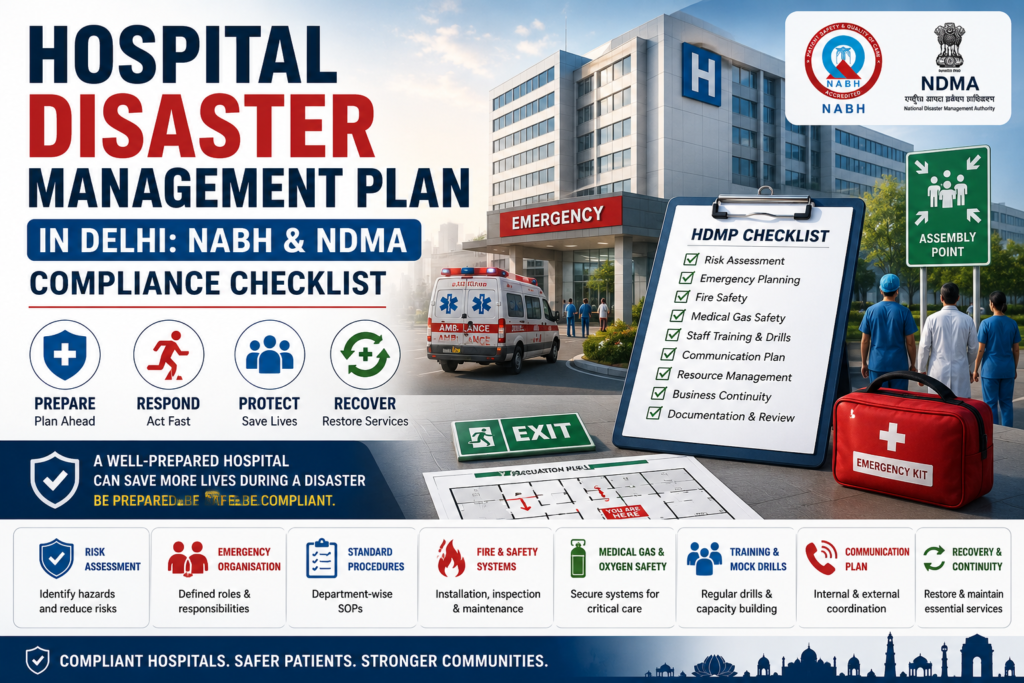
Hospital Disaster Management Plan in Delhi: NABH & NDMA Compliance Checklist
Healthcare facilities are expected to remain operational even when disasters strike. During a fire, earthquake, flood, electrical failure, oxygen leak, or mass casualty incident, the community depends on hospitals more than any other institution. Unlike commercial buildings, hospitals cannot simply evacuate and shut down operations. Intensive Care Units (ICUs), operation theatres, neonatal wards, dialysis units, emergency departments, and oxygen-dependent patients require uninterrupted medical care even during emergencies.
Delhi presents a unique challenge for hospital administrators. The city falls under Seismic Zone IV, experiences frequent fire incidents, urban flooding during monsoon, heat waves, power failures, and increasing pressure on healthcare infrastructure. These risks make disaster preparedness not only a statutory expectation but also an operational necessity.
A well-designed Hospital Disaster Management Plan (HDMP) enables hospitals to protect patients, staff, visitors, infrastructure, and critical medical services while ensuring compliance with national guidelines and accreditation requirements.
Why Every Hospital in Delhi Needs an HDMP
Many hospitals believe that obtaining a Fire NOC or installing firefighting equipment is sufficient for emergency preparedness. Unfortunately, recent hospital fires across India have shown that equipment alone cannot save lives unless staff know exactly what to do during an emergency.
A Hospital Disaster Management Plan provides a structured framework for:
- Identifying hazards specific to the hospital
- Reducing risks before emergencies occur
- Organising emergency response teams
- Protecting critical patients
- Maintaining essential medical services
- Coordinating with external emergency agencies
- Recovering normal operations quickly after a disaster
An effective HDMP transforms emergency response from confusion into coordinated action.
Major Hazards Faced by Hospitals in Delhi
Every hospital should conduct a Hazard Vulnerability Risk Assessment (HVRA) through a qualified disaster manager to identify threats relevant to its location and operations. Typical hazards include:
Natural Hazards
- Earthquake
- Urban flooding
- Heat waves
- Severe storms
- Lightning
Fire and Electrical Hazards
- Electrical short circuits
- Overloaded panels
- Generator room fires
- Kitchen fires
- Laundry fires
- Medical equipment overheating
Medical Hazards
- Oxygen leakage
- Medical gas pipeline failure
- Chemical spills
- Biomedical waste incidents
- Radiation emergencies
Human-Induced Hazards
- Bomb threats
- Violence against healthcare workers
- Crowd management failures
- Cyber attacks
- Terror incidents
The first step in any HDMP is understanding which of these hazards pose the highest risk to the hospital.
NABH Expectations for Hospital Disaster Preparedness
NABH accreditation places strong emphasis on emergency preparedness. Hospitals are expected to have documented, duly signed plans by a disaster manager, trained staff, emergency committees, communication systems, and regular drills.
A compliant hospital should maintain:
- Hospital Disaster Management Plan
- Emergency preparedness policy
- Fire safety policy
- Self-glowing Evacuation Maps
- Disaster Management Committee
- Emergency response teams
- Incident Command Structure
- Resource inventory
- Mutual aid arrangements
- DM Kit
- Mock drill records
- Training records
- Post-incident review system
Documentation alone is not enough. NABH expects hospitals to demonstrate that these systems are functional through regular training and drills.
NDMA Compliance Checklist
The National Disaster Management Authority recommends a comprehensive, multi-hazard approach to hospital safety. A robust Hospital Disaster Management Plan should include:
Governance
✔ Hospital Disaster Management Committee
✔ Incident Commander
✔ Emergency Operation Centre
✔ Emergency contact directory
✔ Coordination with DDMA, Fire Service, Police and Health Department
Risk Assessment through a qualified Disaster Manager
✔ Hazard Vulnerability Risk Assessment
✔ Structural safety assessment
✔ Non-structural safety assessment
✔ Fire risk assessment
✔ Critical infrastructure assessment
Preparedness
✔ Department-wise Standard Operating Procedures
✔ Resource inventory
✔ Staff training
✔ Volunteer management
✔ Emergency communication system
✔ Mutual aid agreements
Response
✔ Fire emergency procedure
✔ Earthquake response
✔ Oxygen leakage response
✔ Medical gas emergency
✔ Bomb threat SOP
✔ Chemical spill response
✔ Mass casualty management
✔ Patient evacuation procedure
✔ Triage protocol
Recovery
✔ Damage assessment
✔ Business continuity
✔ Restoration of critical services
✔ Documentation
✔ Lessons learnt
These components help hospitals meet national disaster preparedness expectations while strengthening operational resilience.
Fire Safety Is Only One Component
Many hospitals invest heavily in fire extinguishers, hydrants, alarms, and sprinklers. These are essential, but they represent only one element of disaster preparedness.
A comprehensive programme should also include:
- Fire Safety Audit
- Electrical safety assessment
- Medical gas safety
- Oxygen manifold safety
- Escape route planning
- Evacuation procedures
- Staff competency
- Communication protocols
- Business continuity planning
Hospitals that focus only on equipment often discover during emergencies that staff are unsure of their responsibilities.
Importance of Self-Glowing Evacuation Maps
One of the most common shortcomings in hospitals is the absence of effective evacuation maps and signage.
During smoke conditions or power failures, ordinary printed evacuation plans become almost invisible.
Photoluminescent or self-glowing evacuation maps provide:
- Visibility without electricity
- Smoke-resistant guidance
- Faster evacuation
- Improved patient movement
- Better compliance with emergency planning
Hospitals should install floor-wise evacuation maps at strategic locations including entrances, lift lobbies, nursing stations, waiting areas, corridors, and staircases.
Staff Training Saves Lives
The most expensive fire protection system becomes ineffective if hospital staff do not know how to use it.
Training should include:
- Fire extinguisher operation
- Patient evacuation
- Horizontal evacuation
- Vertical evacuation
- ICU evacuation
- Wheelchair evacuation
- Oxygen emergency procedures
- CPR
- Basic first aid
- Communication during emergencies
Training should be repeated periodically for all shifts.
Mock Drills Validate the Plan
An untested disaster management plan is only a document.
Mock drills help hospitals:
- Test emergency procedures
- Measure evacuation time
- Identify communication gaps
- Improve coordination
- Build staff confidence
Hospitals should conduct regular drills covering different scenarios rather than repeating only fire drills.
Common Deficiencies Observed During Hospital Audits
Based on field experience, common deficiencies include:
- Outdated Disaster Management Plans
- Incomplete Hazard Risk Assessments
- Non-functional emergency committees
- Blocked escape routes
- Missing evacuation maps
- Poor emergency lighting
- Inadequate staff training
- Missing SOPs
- Expired fire extinguishers
- Lack of mock drill documentation
Most of these issues can be corrected through systematic planning and regular reviews.
How Zone4Solutions Supports Hospitals
Zone4Solutions provides end-to-end hospital disaster preparedness services designed to help healthcare facilities strengthen safety and operational resilience.
Typical services include:
- Rapid Visual Assessment (RVA)
- Hazard Vulnerability Risk Assessment (HVRA)
- Hospital Disaster Management Plan
- Fire Safety Audit
- Thermography
- Formation of Disaster Management Committee
- Incident Command System
- Department-wise SOPs
- Self-glowing evacuation mapping
- Emergency response training
- Tabletop exercises
- Mock drills
- DDMA documentation support
The objective is not merely to prepare a report but to create a practical system that hospital staff can confidently implement during emergencies. Zone4Solutions also emphasizes staff education, establishment of Hospital Emergency Operation Centres, Incident Command Structures, job action sheets, and regular plan testing as key elements of preparedness.
Final Thoughts
Healthcare facilities are among the most critical components of urban resilience. When hospitals remain operational during disasters, entire communities benefit.
Fire protection equipment, emergency plans, trained staff, effective communication, evacuation planning, and regular drills together create a resilient healthcare system. Only a Fire NOC will not save lives.
For hospitals in Delhi, compliance should not be viewed merely as an accreditation requirement. It is an investment in patient safety, staff protection, service continuity, and public confidence.
A well-prepared hospital can continue to deliver life-saving care when the community needs it most.
No Comments