 Collate Ideas For Community Radio Policy

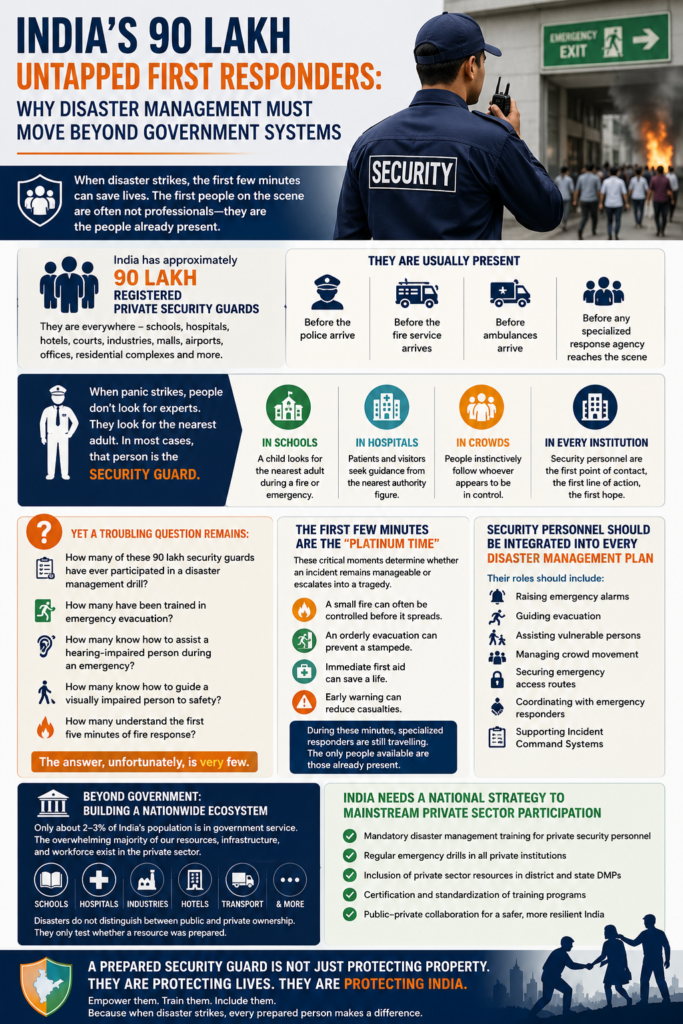
India’s 90 Lakh Untapped First Responders: Why Disaster Management Must Move Beyond Government Systems
Whatever we build over decades, a disaster can destroy in minutes.
A hospital built through years of investment, a school that has educated generations, a hotel that serves thousands of guests, a court delivering justice, or an industrial facility supporting economic growth can all become victims of a single fire, earthquake, flood, structural collapse, or emergency incident.
Yet, despite increasing disaster risks, disaster management often remains the last item on the agenda.
Across the country, institutions invest heavily in infrastructure, security systems, surveillance cameras, access control, and compliance certifications. However, one of the most important resources already present inside these institutions is often overlooked in disaster preparedness planning.
The private security guard.
India has approximately 90 lakh registered private security guards. They stand at the gates, corridors, reception areas, schools, hospitals, hotels, courts, industries, shopping malls, residential complexes, airports, and office buildings across the country.
They are usually present before the police arrive.
Before the fire service arrives.
Before ambulances arrive.
Before any specialized disaster response agency reaches the scene.
When a fire breaks out in a school, a child does not look for a disaster management expert. The child looks for the nearest adult.
When panic develops inside a hospital, patients and visitors seek guidance from the nearest available authority figure.
When a crowd surge develops inside a stadium or public gathering, people instinctively follow whoever appears to be in control.
In most cases, that person is the security guard.
Yet a troubling question remains:
How many of these 90 lakh security guards have ever participated in a disaster management drill?
How many have been trained in emergency evacuation?
How many know how to assist a hearing-impaired person during an emergency?
How many know how to guide a visually impaired person to safety?
How many understand the first five minutes of fire response?
The answer, unfortunately, is very few.
Most private security personnel receive training in access control, visitor management, patrolling, and surveillance. Very few receive structured training in emergency evacuation, fire response, crowd management, first aid, search and rescue, or disaster preparedness.
This reflects a fundamental misunderstanding.
Security management and disaster management are often treated as separate disciplines.
They are not.
A security guard who has never been trained for emergencies does not become irrelevant when disaster strikes. That person becomes either a liability or a lifeline.
The difference is preparation.
Disaster management professionals often refer to the first few minutes following an emergency as the “Platinum Time.” These critical moments determine whether an incident remains manageable or escalates into a tragedy.
A small fire can often be controlled before it spreads.
An orderly evacuation can prevent a stampede.
Immediate first aid can save a life.
Early warning can reduce casualties.
During these critical minutes, specialized responders are still travelling to the scene.
The only people available are those already present inside the institution.
This is precisely why security personnel should be integrated into every Disaster Management Plan (DMP).
Their roles should include:
- Raising emergency alarms
- Guiding evacuation
- Assisting vulnerable persons
- Managing crowd movement
- Securing emergency access routes
- Coordinating with emergency responders
- Supporting Incident Command Systems
Unfortunately, many institutional Disaster Management Plans continue to treat security personnel merely as gatekeepers rather than emergency responders.
This is a missed opportunity.
The issue becomes even more important when we examine India’s broader disaster preparedness ecosystem.
Over the past two decades, India has invested significantly in capacity building through institutions such as the (NIDM), State Disaster Management Authorities, Administrative Training Institutes (ATIs), and various government training academies.
Thousands of government officials have received training in disaster preparedness, emergency response, and disaster risk reduction.
This is undoubtedly a positive development.
However, an important question remains:
What about the private sector?
Government employees constitute only a very small percentage of India’s workforce. Various estimates indicate that only about 2–3 percent of the country’s population is directly employed in government service.
This means that the overwhelming majority of India’s manpower, infrastructure, logistics capability, technical expertise, and financial resources exist outside government systems.
Our schools, hospitals, industries, hotels, IT parks, warehouses, shopping malls, transport fleets, and communication networks are largely operated by the private sector.
Even critical human resources such as security personnel, facility managers, engineers, maintenance teams, drivers, and support staff belong predominantly to the private sector.
Yet disaster management capacity building remains heavily focused on government officials.
Disasters do not distinguish between public and private ownership.
When a major earthquake strikes, a flood inundates a city, or a large fire breaks out, affected communities seek assistance from whatever resources are available nearby.
The disaster does not ask whether a resource belongs to the government or a private company.
It only tests whether that resource was prepared.
India therefore requires a national strategy for integrating private sector resources into disaster preparedness and response.
Such a strategy should include:
- Training private security personnel
- Institutional disaster management planning
- Emergency volunteer programs
- Resource inventory databases
- Public-private disaster partnerships
- Capacity building for private institutions
- Regular mock drills and simulation exercises
The objective should not merely be regulatory compliance.
The objective should be preparedness.
Large industries can provide logistics support during disasters.
Hotels can serve as temporary shelters.
Hospitals can expand surge medical capacity.
Educational institutions can function as relief centres.
Transport operators can support evacuation and relief movement.
Private security personnel can become the first layer of emergency response.
Collectively, these resources represent one of the largest untapped disaster response capacities in the country.
Another critical area that requires attention is inclusive disaster preparedness.
Unfortunately, most emergency systems are designed only for physically healthy individuals.
Emergency sirens assume that everyone can hear.
Evacuation maps assume that everyone can see.
Emergency instructions assume that everyone can understand them in the same way.
But what about hearing-impaired persons?
What about visually impaired individuals?
What about elderly occupants?
What about wheelchair users?
What about persons requiring assisted evacuation?
A truly resilient disaster management system must work for everyone.
This requires:
- Visual alarm systems
- Flashing strobe lights
- Accessible emergency communication
- Braille signage
- Tactile pathways
- Inclusive evacuation planning
- Trained support personnel
Private security personnel can play a crucial role in this process if they are properly trained.
As India continues to invest in infrastructure, urbanization, tourism, education, healthcare, and industrial growth, preparedness must receive equal attention.
We often celebrate new buildings, new facilities, and new investments.
But resilience is not measured by what we build.
It is measured by how well we protect it.
The security guard standing at the gate is not merely protecting property.
During an emergency, that individual may become the first responder, the evacuation guide, the communicator, the rescuer, and the difference between order and chaos.
India already has 90 lakh potential first responders standing inside its institutions.
The question is not whether they will be present during the next disaster.
The question is whether we will train them before the next disaster tests them.
So there is an opportunity for the private sector to start a capacity building institutions and serve a large part of the pie.
No Comments