 Collate Ideas For Community Radio Policy

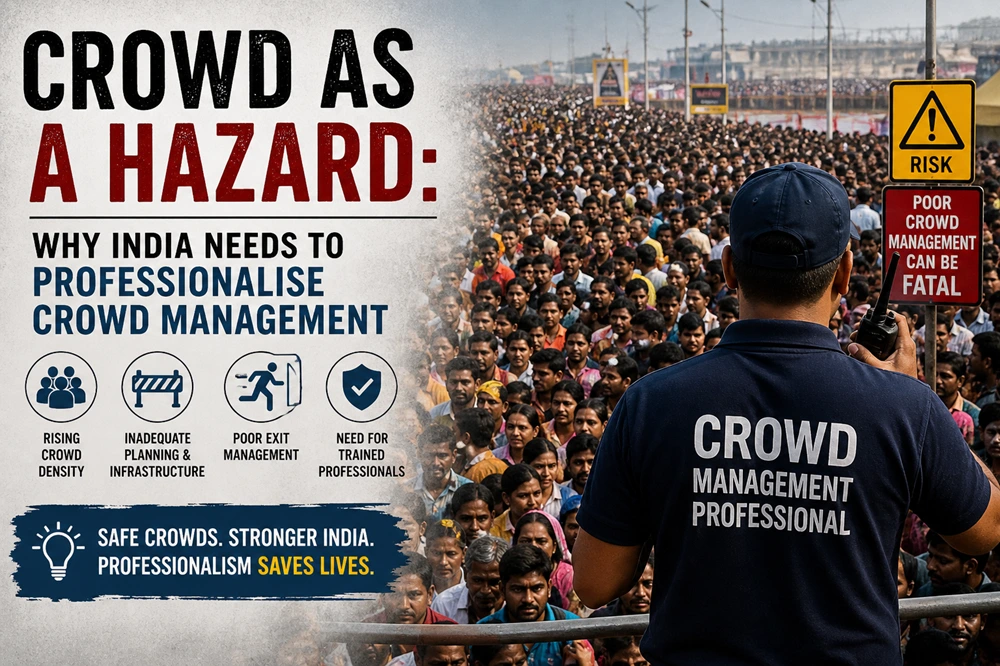
Crowd is not merely a social phenomenon; it is a dynamic risk system. When density, movement, environment, and human behaviour interact under pressure, a routine gathering can escalate into a life-threatening situation within seconds. Globally, crowd disasters have occurred in religious congregations, concerts, sporting events, transport hubs, and political rallies. In a high-density country like India, where daily life itself involves navigating large gatherings, crowd risk is an everyday hazard.
Yet, crowd management is often treated as an extension of policing focused on law and order, rather than as a specialised, technical discipline grounded in engineering, behavioural science, and risk analytics. As a disaster management practitioner, it is clear that India needs to move from reactive policing to proactive, science-based crowd management. This article argues for that transition, outlines the technical foundations, and draws lessons from case studies.
- Understanding Crowd as a Hazard
A “crowd” becomes a hazard when density exceeds safe thresholds or when movement is constrained in ways that amplify pressure and panic. The most critical metric is people per square meter (p/m²):
- 1–2 p/m²: Comfortable movement; individuals retain control.
- 3–4 p/m²: Movement slows; physical contact increases.
- 5–6 p/m²: Risk zone; movement becomes involuntary; pressure waves form.
- 6+ p/m²: Critical danger; “crowd crush” conditions can develop; individuals may asphyxiate without falling.
Contrary to popular belief, many fatalities in crowd disasters are not due to “stampede” (people running wildly). Still, due to compressive asphyxia, people are squeezed so tightly that breathing becomes impossible. Small perturbations (a sudden stop, a bottleneck, a rumour) can propagate as shockwaves through dense crowds, causing falls and pile-ups.
- Why India Is Especially Vulnerable
India hosts some of the largest human gatherings in the world:
- Religious events (Kumbh Mela, temple festivals, yatra routes)
- Political rallies and public celebrations
- Urban transit hubs (railway stations, bus terminals)
- Commercial hubs and markets
- Stadium events and concerts
Key vulnerability factors include:
- High baseline density: Every day, public spaces are already crowded.
- Informal infrastructure: Temporary arrangements at melas/fairs with variable standards.
- Mixed-use spaces: Pilgrims, vendors, VIP routes, and emergency lanes often overlap.
- Behavioural triggers: Devotion, urgency, rumour, weather, or VIP movement can rapidly alter crowd dynamics.
- Limited data-driven planning: Capacity is often estimated loosely rather than calculated.
- From Policing to Professional Crowd Management
Policing plays a critical and indispensable role in ensuring law and order, security enforcement, and incident response during public gatherings. Police forces are trained to manage threats such as violence, crime, and disorder. However, crowd safety is governed by distinct dynamics rooted in physics, human behaviour, spatial design, and real-time risk management. Treating crowd safety purely as a policing function often leads to gaps that can escalate into disasters.
- Fundamental Difference in Objectives
The primary objective of policing is control and enforcement, whereas crowd management focuses on safety, flow, and risk reduction. While police may intervene to stop unlawful behaviour, crowd managers must ensure that the environment itself does not create unsafe conditions such as excessive density, bottlenecks, or conflicting movement patterns.
- Understanding Crowd Dynamics vs. Crowd Control
Crowd safety requires an understanding of crowd science, including:
- Density thresholds (persons per square meter)
- Flow rates and movement patterns
- Behavioral responses under stress
- Formation of pressure waves in dense crowds
In high-density conditions, individuals lose personal control, and the crowd behaves like a fluid system. At this stage, traditional policing methods such as pushing, blocking, or redirecting crowds without planning can increase risk rather than reduce it.
- Infrastructure and Design-Based Approach
Crowd safety depends heavily on design and planning, including:
- Adequate entry and exit capacity
- Elimination of bottlenecks and choke points
- Clear zoning and sectorization
- Visible signage and wayfinding systems
Policing alone cannot compensate for poor infrastructure design. A well-designed space can passively manage crowds, while a poorly designed one can become hazardous even under heavy police presence.
- Real-Time Monitoring and Decision-Making
Effective crowd management requires continuous monitoring of density and movement through:
- CCTV analytics
- Drone surveillance
- On-ground observers
Decisions must be based on predefined thresholds, such as restricting entry when density approaches critical levels. This is a data-driven approach, distinct from reactive policing.
- Communication as a Safety Tool
Clear and timely communication is a cornerstone of crowd safety. Public address systems, digital displays, and trained personnel help guide crowd behaviour. In contrast, lack of communication often leads to panic, rumour spread, and sudden surges, which are common triggers of disasters.
- Multi-Agency Coordination
Crowd safety is inherently multi-disciplinary, involving:
- Disaster management experts
- Fire and emergency services
- Medical teams
- Urban planners and engineers
Policing is one component of this ecosystem, but effective coordination across agencies is essential for comprehensive risk management.
- Training and Professionalisation
Unlike policing, which follows established command structures, crowd management requires specialized training in:
- Risk assessment
- Evacuation planning
- Behavioral psychology
- Emergency response protocols
The absence of trained crowd management professionals often results in reliance on ad hoc measures.
While policing remains essential for maintaining order and responding to incidents, crowd safety demands a proactive, scientific, and system-based approach. It requires planning, design, monitoring, and communication, elements that go beyond traditional policing. Integrating these approaches is crucial for preventing crowd disasters, particularly in high-density environments such as India.
Policing is essential for security and law enforcement, but crowd safety requires a different toolkit:
| Policing Focus | Crowd Management Focus |
| Law & order | Safety & flow |
| Static deployment | Dynamic density control |
| Response to incidents | Prevention via design & modeling |
| Command hierarchy | Integrated, multi-agency coordination |
A professional approach integrates planning, design, operations, and real-time monitoring.
- Technical Foundations of Crowd Management
4.1 Capacity Planning
- Gross capacity: Total area × safe density (typically ≤ 3–4 p/m² for events).
- Net usable area: Excludes stages, stalls, and obstacles.
- Ingress/Egress capacity: Number and width of gates; throughput per minute.
- Travel time: Time to clear the venue under normal and emergency conditions.
4.2 Flow Engineering
- Unidirectional movement where possible.
- Segregation of entry and exit streams.
- Bottleneck elimination (narrow gates, turns, choke points).
- Holding areas to meter inflow.
4.3 Zoning and Mapping
- Sectorization: Divide the venue into manageable zones with defined capacities.
- Clear signage: Wayfinding, exits, assembly points.
- Emergency corridors: Dedicated, unobstructed lanes.
4.4 Threshold-Based Triggers
- Predefined action thresholds (e.g., 4 p/m² = slow inflow; 5 p/m² = halt entry; 6 p/m² = initiate controlled dispersal).
- Decision trees for incident commanders.
4.5 Real-Time Monitoring
- CCTV analytics (density estimation, heat maps).
- Drone feeds for large venues.
- On-ground observers reporting via radio.
4.6 Communication Systems
- Public address systems with clear, calm instructions.
- Multi-lingual messaging.
- Rumour control protocols.
4.7 Medical & Emergency Preparedness
- First-aid posts within 3–5 minutes’ reach.
- Triage zones.
- Ambulance access routes kept clear at all times.
- Case Studies: Lessons from Successes and Failures
Case Study 1: Kumbh Mela (India) – From Risk to Model
Context: One of the largest gatherings globally, with tens of millions of pilgrims.
Interventions (recent editions):
- Detailed sector planning with controlled capacities.
- Route engineering with one-way movement on peak days.
- Extensive signage and public announcements.
- Integrated command centers with real-time surveillance.
- Coordination across police, health, transport, and municipal bodies.
Outcome: Significant reduction in major incidents compared to earlier decades.
Lesson: Scale is manageable when planning is data-driven and multi-agency.
Case Study 2: Sabarimala Pilgrimage (Kerala)
Context: Mountainous terrain, seasonal peaks, narrow pathways.
Challenges:
- Constrained routes and steep gradients.
- Sudden surges near sanctum areas.
- Mixed pedestrian and service movement.
Interventions:
- Queue management systems and virtual queueing.
- Time-slotting and flow regulation.
- Improved lighting, barricading, and communication.
Lesson: In constrained geographies, flow control and scheduling are critical.
Case Study 3: Love Parade, Germany (2010)
Context: Electronic music festival; access via a single tunnel.
Failure Points:
- Severe bottleneck at the tunnel.
- Poor ingress/egress segregation.
- Inadequate communication and crowd control.
Outcome: 21 fatalities due to crowd crush.
Lesson: Single-point access is a design failure. Redundancy and multiple exits are non-negotiable.
Case Study 4: Hajj (Saudi Arabia) – Engineering at Scale
Context: Annual pilgrimage with millions performing synchronised rituals.
Interventions:
- Multi-level structures (e.g., Jamarat Bridge) to distribute density.
- Strict time-slot allocations.
- Real-time monitoring and rapid response units.
- Continuous infrastructure upgrades based on post-event analysis.
Outcome: Major improvements in safety over time.
Lesson: Combine infrastructure design + scheduling + technology.
Case Study 5: Railway Station Surges (India)
Context: Festive seasons, delays, platform changes.
Failure Points:
- Sudden information changes (platform shifts).
- Narrow foot-over-bridges acting as choke points.
- Lack of staggered entry.
Lesson: Information management is as important as physical design.
- Common Causes of Crowd Disasters
- Bottlenecks and choke points
- Overcapacity without monitoring
- Bidirectional flows in narrow passages
- Sudden triggers (rain, rumors, VIP movement)
- Poor signage and communication
- Inadequate emergency access
- Lack of trained personnel
- Building a Professional Framework for India
7.1 Standards and Guidelines
- Adopt national guidelines aligned with global best practices.
- Mandate capacity calculations and evacuation plans for all large events.
7.2 Certification and Licensing
- Require certified crowd managers for events above defined thresholds.
- Event permits linked to approved crowd management plans.
7.3 Education and Training
- Introduce crowd science modules in disaster management courses.
- Regular mock drills for organizers and responders.
7.4 Technology Integration
- AI-based density estimation.
- Mobile dashboards for incident commanders.
- Digital ticketing and time-slotting.
7.5 Community Awareness
- Public messaging on safe behaviour in crowds:
- Avoid pushing
- Follow instructions
- Use designated routes
- Integrating Crowd Management into Disaster Management Planning
Crowd risk must be embedded in:
- City Disaster Management Plans (CDMP)
- Institutional plans (schools, colleges, stadiums, malls)
- Transport hub SOPs
Key inclusions:
- Venue-specific RVS (Rapid Visual Screening) for crowd risk
- Evacuation mapping with visible signage
- Threshold triggers and command protocols
- Inter-agency coordination matrices
- Practical Toolkit for Event Organizers
- Calculate safe capacity (don’t exceed 3–4 p/m²).
- Design separate entry/exit routes.
- Eliminate bottlenecks; widen or add exits.
- Install clear signage and PA systems.
- Deploy trained stewards (1 per 250–500 people, depending on risk).
- Monitor density in real time.
- Keep emergency lanes clear.
- Plan for worst-case evacuation time.
- Conclusion: From Habit to Science
India has demonstrated excellence in managing massive gatherings when it adopts a scientific, systems approach. However, many events still rely on ad hoc arrangements and policing alone. The time has come to professionalise crowd management, to treat it as a core component of disaster risk reduction.
Crowd is predictable when measured, manageable when designed, and safe when monitored.
By investing in education, standards, and technology, India can transform an everyday hazard into a well-managed system, saving lives while enabling the cultural and social vibrancy that large gatherings represent.
Zone4Solutions specialises in developing comprehensive crowd management systems for all types of gatherings. Our approach covers detailed planning of routes, movement flows, space utilisation, and strategic barricading, ensuring safe and efficient crowd handling.
We design solutions based on crowd density thresholds, risk assessment, and real-time management principles, making them practical and implementable across events such as religious gatherings, public rallies, stadium events, institutional functions, and urban spaces.
You can connect with us for end-to-end crowd management planning, risk assessment, and training support tailored to your specific event or venue.
No Comments